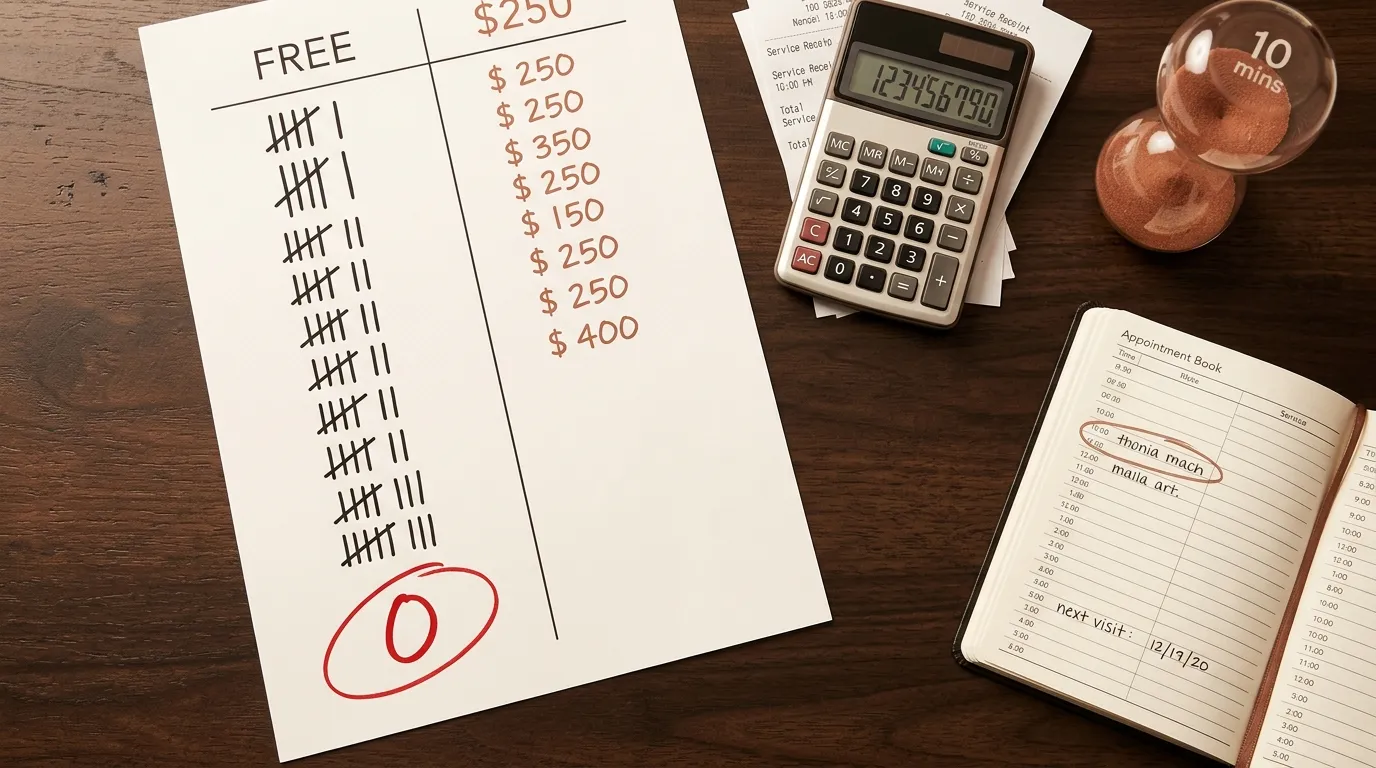
Removal should be free. A loyal client should never pay for the privilege of having her own gel taken off, and a walk-in who just wants the old set soaked deserves the courtesy. Most books still run on that logic: the soak-off folded silently into the next service, comped for the regular, performed for nothing for the client who leaves without booking anything. The math disagrees, and the disagreement is worth roughly $17,000 a year.
Free Removal Sounds Like Loyalty
The belief splits into two arguments. The loyalty argument says a removal fee punishes the clients who come back, so the charge gets waived for regulars and absorbed into the set. The courtesy argument says a soak-off is too small to bill, that a $10 line beside a $40 manicure looks petty.
Both arguments misread what removal is. The soak-off is a service with a protocol, a duration, and a wage attached, and it is the only item on the menu routinely sold at zero. No other 25-minute block of chair time works unpaid. The habit survived because nothing on a month-end report ever shows a removal line at $0. Time is the only currency it spends, and the appointment book absorbs time quietly.
Why the Free Soak-Off Habit Survives
The habit started when gel was an upsell. The client who paid extra for gel was a premium ticket, and comping the soak-off read as generosity funded by margin. Then gel stopped being an upgrade and became the default, and the courtesy became a standing cost nobody repriced.
Fear keeps it alive. The tech who considers a fee pictures the regular’s face and hears the sentence “since when?” The fear is louder than the arithmetic, which is the same instinct the price-increase playbook dismantles: clients rarely leave over one line item, and the ones who threaten to were already halfway out. What the fear never accounts for is that the regular already pays for removal. She pays for it inside the set price, invisibly, every visit.
How Much to Charge for Gel Removal
Start with the clock. The standard soak-off runs a 15-minute acetone wrap before any lifting begins, per removal guidance from OPI and JINsoon educators. Add filing the top coat, wrapping ten fingers, sliding off residue, and cuticle oil cleanup, and a standalone soak-off occupies 20 to 30 minutes of chair time. Call it 25.
Then the wage. The Bureau of Labor Statistics puts the median wage for manicurists and pedicurists at $17.19 an hour for 2025, per O*NET’s occupational summary. Twenty-five minutes at that rate is $7.16 of labor billed at zero.
The sharper figure is the chair’s earned rate. Boulevard’s 2026 nail price benchmarks put a gel manicure at $30 to $45. At $40 for a 45-minute slot, the chair earns $53.30 an hour. A 25-minute soak-off with no fee displaces $22.20 of that capacity. Three walk-in removals a day, five days a week, is 1.25 hours billed at nothing: about $66 a day, $333 a week, $17,300 a year.
How much to charge for gel removal follows from those two rates. A $10 fee on a 25-minute soak earns $24 an hour, above the median wage and still under the chair’s gel rate, which is the correct posture for an add-on. A $5 fee earns $12 an hour, less than the same hands make at the median, and reads as a gesture instead of a price. Acrylic carries this further: the drill work and longer soak can push past half an hour, which is why removal lines for acrylic sit higher than gel ones. Whether the client wears gel or acrylic changes the protocol and the clock. The clock stays billable either way.
Soak Off Nails Price: Three Structures, Stress-Tested
The soak off nails price on menus that bother to list one lands between $5 and $10. The number matters less than the structure around it. Three ways to run removal, each stress-tested against what it does to rebooking:
| Structure | Soak-off alone, no next visit | With a new set at this visit | Bare soak-off earns | What it protects |
|---|---|---|---|---|
| Flat fee, always | $10 | $10 | $24/hr | The book, from free riders |
| Priced into the set | $10 | $0 extra | $0, covered by the ticket | The checkout conversation |
| Free with a rebook | $10 | $0, next set booked first | $0 or $24/hr | The calendar |
The flat fee is the bluntest tool. It stops the walk-in who soaks and leaves, and it charges the client who always rebooks the same as the one who never does.
Pricing removal into the set is the industry default, and the math shows its cost. A $40 set over 45 minutes earns $53.30 an hour; the same $40 over 70 minutes with removal bundled earns $34.30. The structure works only if the set price was built for 70 minutes, a job for the cost-per-service pricing formula. The same logic prices dip powder, where soak-off time runs comparable.
Free with a rebook turns the fee into a retention lever. Removal costs nothing the moment the next appointment is on the calendar, and $10 when it isn’t. Boulevard’s client retention research found that 70% of clients who book a second appointment go on to book a third, which makes the rebooked slot worth more than any single fee. This structure pays for the client’s removal in the one currency the salon actually needs.
What to Say to Regulars
The scripts are short, and they work best delivered as policy rather than apology.
To the regular with the old habit: “Starting next month, soak-offs are $10 unless your next appointment is on the books. I’d rather waive it, so let’s find your slot before you leave today.”
To the walk-in: “A soak-off on its own is $10. If you’re getting a new set today, removal is included.”
To the client mid-set who asks why: “The soak takes the same half hour as a fill. Free when it’s part of the next set, ten dollars when it isn’t.”
None of these sentences need justification beyond the clock. Removal takes time, time is the inventory, and the rebook is the discount.
The Rule That Does the Work
One rule replaces the habit: removal is free the moment the next set is booked, and $10 when the chair stays empty afterward. The ten dollars does one job. It makes the calendar the trigger, and the calendar was the asset all along.