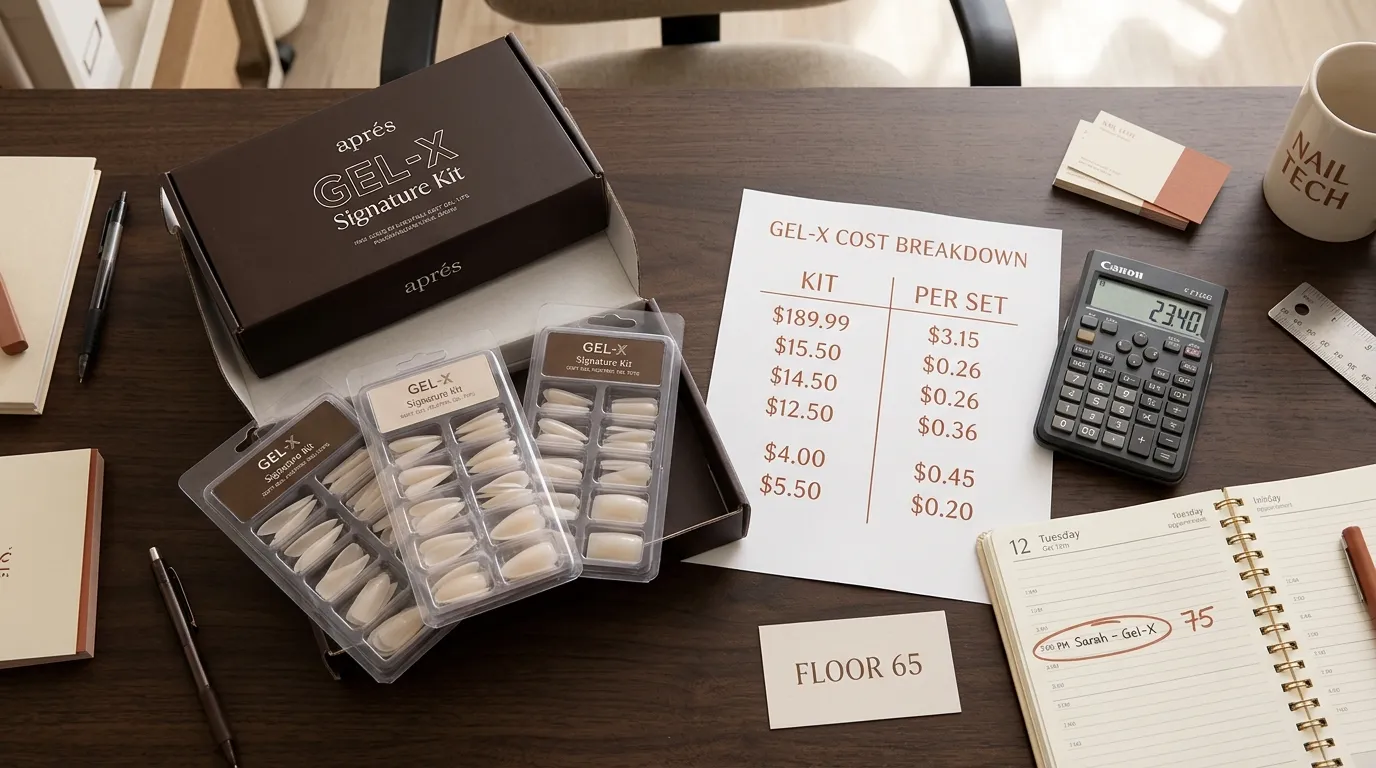
$99.99 buys the complete Aprés Gel-X Signature kit: 280 pre-sized soft gel tips, Extend Gel, pH bonder, nail prep, top coat, a flash-cure lamp, a file, and a buffer, per the current dealer listing. Add the one-day certification class, which runs $397 to $699, and the entire launch of soft gel extensions lands between $500 and $800. No other extension system enters a salon that cheaply. The investment is the easy part. What decides payback gets set before the first client sits down: minutes per set, and a price floor that keeps the service from becoming a gel manicure that takes longer.
What a Gel-X Starter Kit Costs
The Signature kit covers the chemistry end to end. Everything that touches the service comes in the box, including the lamp for flash-curing each tip, and the formula is HEMA- and TPO-free, which matters for the sensitized clients the allergy guide describes. One gap to check before ordering: the kit’s Omni Light is a flash-cure unit, and Aprés directs the final cure to a full-size LED lamp. A salon already offering gel manicures owns that lamp, so the add-on cost is zero for most operators.
The recurring cost is the one that matters more than the launch cost. A working tech’s set consumes $8 to $15 in tips and Extend Gel, according to Lutily’s year-long comparison of Gel-X and sculpted extensions, which logs roughly 400 sets of each system. At a $65 ticket, materials take 12 to 23 percent and $50 to $57 stays with the chair. Against a $500 to $800 launch, the service pays for itself across 10 to 16 paying sets, which is under two weeks of a moderately converted book.
Training Time and What the Certificate Buys
The class is a single day. Most Gel-X certification courses run 4 to 6 hours and cost $397 to $699, per Sublime Professional’s April 2026 training guide, which also states the boundary that matters legally: a Gel-X certificate is a technique credential, never a license, and 49 of 50 states require a nail license to charge for the work. Aprés runs its own official certification through Aprés University as a one-day class with an educator, restricted to licensed techs and cosmetologists, with a new self-paced online option for flexible learners.
The class teaches the system. The speed comes from repetition after it. Application guides converge on 45 to 75 minutes for a first full set and 30 to 45 minutes once the hands know the steps, per the Nails Industry Directory’s Gel-X breakdown. The operational translation: schedule practice sets on models at materials cost for two weeks before the service reaches the book, then open the menu with a 75-minute slot and compress it as the timed sets come in.
The class also sets the safety posture the salon inherits: keep uncured Extend Gel off the skin and cure for the full time, because sensitization risk sits in the bond gel, and the chemistry behind that rule is the same polymerization covered in nail product chemistry.
Soft Gel Extensions vs Acrylic at the Chair
Gel-X occupies the slot between the gel manicure and the sculpted set. Soft gel tips arrive factory-cured and pre-shaped, bonded over the whole plate with Extend Gel; there is no bead, no monomer odor, and almost no filing of the natural nail. Liquid-and-powder acrylic builds a harder, more rigid structure by hand, which is exactly the trade the salon’s gel-versus-acrylic framework sorts client by client.
The chair math puts the new service in position:
| Service | Chair time | Typical price | Hourly yield |
|---|---|---|---|
| Gel manicure | 45 min | $30-45 | $40-60 |
| Gel-X full set, trained | 45-60 min | $65-85 | $65-102 |
| Acrylic full set | 60-90 min | $55-100+ | $44-67+ |
The price bands come from Boulevard’s 2026 nail price benchmarks, which put gel manicures at $30 to $45 and acrylic extensions at $30 to $100+, and from Lutily’s working-station numbers, where an $85 Gel-X set over 50 minutes earns $102 an hour against $90 an hour for a $120 sculpted set over 80 minutes. Faster per appointment, lower ticket, higher hourly yield. That is the bridge in one line.
The fill cycle is the difference new Gel-X techs miss. Acrylic clients return every two to three weeks for infills at $20 to $45, per Boulevard, and sculpted clients generate more lifetime revenue for the same reason. Gel-X sets wear two to four weeks and then come back as a soak-off and a fresh set, since the tip system fills poorly. The salon trades a retention loop for a throughput loop, and Lutily’s year-long log of wear, fills, and client response is the honest record of how that trade plays out on real clients. Salons running tight books convert more hourly capacity with Gel-X; salons with room to fill build more recurring revenue on acrylic.
Gel-X vs Dip Powder: Which Client Converts
The dip client is the easiest conversion on the menu. Dip powder delivers durability on natural length, and the dip menu math shows why salons added it: low startup, no lamp required, familiar chemistry. What dip cannot do is add meaningful length, and the client who has been asking for length without the acrylic drill is the one who books the first Gel-X slot. After her come the gel manicure regulars whose natural nails chip or break at two weeks, and the lapsed acrylic clients who left over the odor and the dust. The service sells itself to exactly three clients already in the book, which is why the launch rarely needs marketing spend.
How to Price Gel-X Extensions
Price against the clock, never against the neighbors on the menu. The salon’s incumbent benchmark is the gel manicure: $40 in a 45-minute slot earns $53.30 an hour. Every Gel-X price has to clear that number per minute, because a service that earns less per hour than the manicure beside it is cannibalizing the book.
The failure mode arrives in month one. A tech still learning the system books 75-minute slots, charges $55 to stay competitive, and earns $44 an hour, below the salon’s own gel rate. The fix is a floor set in advance: price divided by minutes, times 60, must beat $53.30. A 60-minute slot clears it at $65 ($65 an hour) and clears it comfortably at $75. Metro operators push higher; Lutily’s station runs $85 sets in 50 minutes, and premium markets charge $120 to $200 for bespoke sets with art, per the Industry Directory.
Three rules hold the floor after launch:
- Book 75 minutes for the first month, price for 60. The tech compresses toward 50 minutes as the timed sets accumulate, and the extra 10 to 15 minutes becomes recoverable capacity instead of a refund conversation.
- Bill the soak-off separately. Removal runs a 15 to 20-minute acetone soak before the new set even starts, and a set priced as if removal were free is a set priced below its own floor.
- Reprice when the clock stabilizes. Once sets hold under 50 minutes for two consecutive weeks, the same ticket earns a higher hourly without a price change; hold prices and bank the speed.
The Floor Decides It
The kit costs $99.99, the class costs a day, and the service fails for one reason: a price set against the manicure menu instead of the clock. At $65 for a disciplined hour, Gel-X out-earns the gel manicure it upgraded and the acrylic set beside it, and the launch pays for itself before the first tip box runs out.