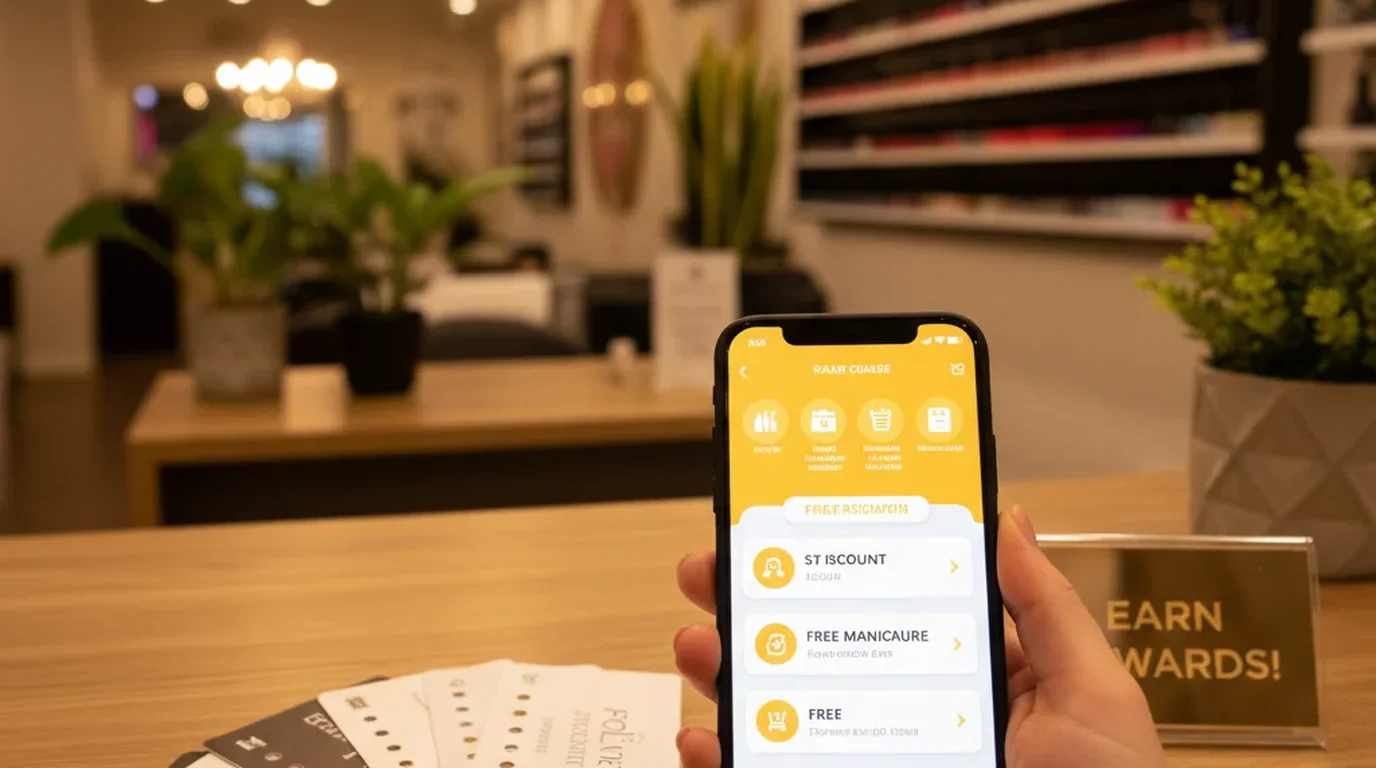
Repeat clients make up roughly 42% of a typical nail salon’s customer base but generate around 80% of total revenue. Meanwhile, 73% of customers say they would be more likely to choose a salon that offers a loyalty or membership program. The math is clear: a structured rewards program is not optional if you want steady revenue growth.
But not all loyalty programs produce results. Some bleed margin without moving the needle on retention. Here is what actually works, what does not, and how to tell the difference.
Punch Cards vs. Digital Programs
The classic paper punch card still shows up in nail salons everywhere. Print a stack for $30, hand them out, stamp one per visit, give a free service after 10. It is simple, familiar, and has zero learning curve for staff or clients.
The problem: 39% of customers abandon paper loyalty programs because they lose or forget their cards. Paper cards are also easy to counterfeit, impossible to track at scale, and give you zero data about visit frequency or spending patterns.
Digital loyalty programs solve all three issues. A phone-based system keeps the “card” in the client’s pocket at all times, eliminates fraud, and lets you see exactly how often each client visits, how much they spend, and when they are at risk of churning.
Here is a side-by-side comparison:
| Factor | Paper Punch Card | Digital Program |
|---|---|---|
| Setup cost | $30 to $50 for printed cards | $0 to $49/month (software) |
| Client abandonment | ~39% lose or forget cards | Near zero (phone-based) |
| Fraud risk | High (easy to duplicate) | None (system-tracked) |
| Customer data | None | Full visit and spending history |
| Automated outreach | Not possible | Push notifications, texts, emails |
| Staff training needed | Minimal | 1 to 2 hours |
For a solo nail tech doing 15 clients a week, a paper punch card is fine. For a salon doing 80+ clients a week with multiple technicians, digital is the only option that scales.
Loyalty Program Structures That Drive Repeat Visits
Three models work consistently for nail salons. The right one depends on your average ticket size and service mix.
Visit-Based Rewards (The Punch Card Model)
Every Nth visit earns a reward. Example: every 10th manicure is free, or every 8th visit earns a $15 credit. This is the simplest structure and the easiest to explain. It works best for salons where most clients get the same service at a similar price point.
Best for: salons focused on one or two core services (gel manicures, basic pedicures).
Points-Per-Dollar
Clients earn 1 point for every dollar spent. Points accumulate and unlock rewards at thresholds (100 points = $10 off, 250 points = free gel set). This model rewards higher-spending clients proportionally and naturally encourages upsells on add-ons like nail art, paraffin dips, or hand treatments.
Best for: salons with a wide service menu and varying price points.
Monthly Membership
A fixed monthly fee covers a set number of services, plus discounts on extras. For example: $65/month for two gel manicures (normally $40 each) plus 15% off any add-on service. Membership-based salons that execute this well see 15% to 25% higher retention compared to single-service bookings. Memberships accounted for 21% of all nail salon revenue in 2023, second only to services themselves.
Best for: salons with a strong base of regulars who visit every two to three weeks.
Loyalty Program Mistakes to Avoid
Overly complex tier systems. Bronze/Silver/Gold/Platinum structures borrowed from airlines confuse salon clients. If someone needs a chart to understand their status, you have lost them. Keep it to two tiers at most.
Rewards that take too long to earn. If a client needs 20 visits to earn a free basic manicure, they will mentally check out by visit 5. Salons with loyalty programs see a 9% increase in guests visiting five or more times per year, but only when the first reward is achievable within 6 to 8 weeks of normal visit frequency.
Discounts on services you are already discounting. Stacking a loyalty reward on top of a promotion undercuts your margins twice. Structure rewards around full-price services or add-ons instead.
No communication after enrollment. Signing someone up and never reminding them of their points is the same as not having a program. Automated texts showing point balances after each visit keep the program visible.
Implementation Costs
You do not need enterprise software to run a loyalty program. Here are real costs for the most common options.
Square Loyalty comes bundled with Square’s Plus plan at $49/month per location. If you already use Square for payments, adding loyalty is straightforward. The system automatically tracks visits and spending, sends point balance updates, and integrates with your existing POS.
GlossGenius includes loyalty features in its Standard plan at $24/month ($28 if billed monthly). The platform also covers booking, payments, and marketing. For a nail salon that needs an all-in-one system, this is one of the more affordable entry points.
Standalone apps like Stamp Me or Glue Loyalty range from free (limited features) to $25 to $50/month for full functionality. These work if you want digital loyalty without switching your entire POS.
Paper punch cards cost $30 to $50 to print a batch of 500 to 1,000. No monthly fees, but also no data, no automation, and the 39% abandonment rate mentioned above.
How to Measure Your Salon Loyalty Program ROI
A loyalty program is an investment. Track these numbers monthly to know if it is returning more than it costs.
Repeat visit rate. What percentage of clients who visited in month 1 came back in month 2 or 3? Top-performing nail salons hit 69% rebooking rates. If your loyalty program is working, this number should climb steadily.
Average visits per client per year. Track this before launching your program and again at 3, 6, and 12 months. A working program should increase visits by at least 1 to 2 per year per active member.
Redemption rate. If fewer than 20% of enrolled clients ever redeem a reward, the program is not motivating behavior. If more than 80% redeem, your rewards might be too easy to earn and you are giving away margin. Aim for 40% to 60%.
Revenue per loyalty member vs. non-member. This is the number that matters most. If loyalty members spend more per year than non-members (they should), the difference minus program costs is your ROI. A healthy loyalty program should show members spending 15% to 25% more annually.
Cost per retained client. Divide your total loyalty program cost (software fees plus the cost of rewards given) by the number of clients who would have churned but did not. Compare this to your client acquisition cost. Retention should be cheaper. If acquiring a new client costs $50 to $127 and retaining one through loyalty costs $5 to $15, the program is working.
How to Start a Nail Salon Loyalty Program
Pick the simplest structure that fits your salon. If you are not sure, start with a visit-based digital program: every 8th visit earns a $15 credit. Set it up in whatever POS you already use (or adopt one that includes loyalty). Run it for 90 days, measure repeat visit rates before and after, and adjust from there. For more ways to keep clients coming back, see our client retention strategies.
The salons that get loyalty right are not the ones with the fanciest programs. They are the ones that actually track results and tweak the structure until the numbers work. If no-shows are undermining your retention efforts, our guide on reducing no-shows covers practical fixes.