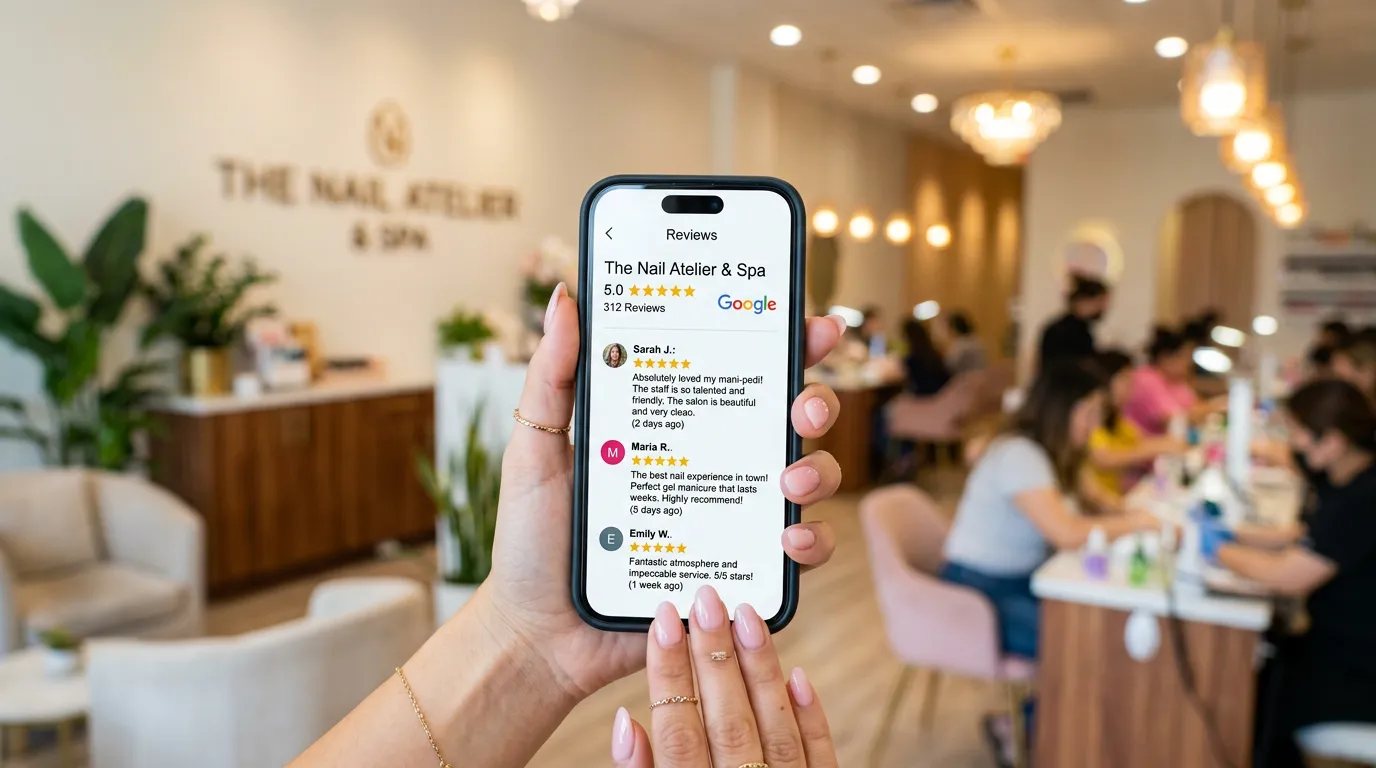
Your nail salon could have the best techs in the city, but if your Google listing shows 3.6 stars and an unanswered complaint about gel peeling, you’re losing clients before they ever walk through the door. According to BrightLocal, 97% of consumers read online reviews for local businesses, and 84% trust them as much as a personal recommendation (BrightLocal). Reviews are not optional anymore. They’re the front door to your business.
Here’s how to manage them without losing your mind.
Why Google Reviews Matter for Nail Salons
Reviews don’t just influence whether someone books. They directly affect whether anyone finds you in the first place. Google’s local search algorithm weighs review signals (quantity, velocity, diversity, and response rate) as roughly 15% of Local Pack ranking factors (BrightLocal). Businesses with 50 or more Google reviews rank on average 18% higher in local search results.
The revenue numbers are just as real. A one-star increase on Yelp correlates with up to a 9% revenue increase for independent businesses. Customers spend 31% more at businesses with excellent reviews, and businesses with positive reviews earn 22% more revenue overall (Podium).
Four or more negative reviews on your Google Business Profile can drive away up to 70% of potential customers. That’s not a branding problem. That’s a math problem.
Google vs. Yelp: Where to Focus
If you have limited time (and you do), prioritize Google. Google hosts roughly 73% of all online reviews and is the platform 87% of consumers use to evaluate local businesses. Your Google Business Profile shows up in Maps, local search, and the Local Pack. That’s where most nail salon discovery happens.
Yelp still matters, especially for salons. Yelp reviews tend to be longer and more detailed (60% are three sentences or longer), and the platform carries weight in beauty and personal care categories. But Yelp’s aggressive review filter hides reviews it considers less trustworthy, and you can’t ask for Yelp reviews without risking penalties. Yelp explicitly discourages solicitation.
The practical split: Actively build your Google review count. Let Yelp reviews come organically. Respond on both platforms.
How to Ask Nail Clients for Google Reviews
The biggest barrier to getting reviews is that clients forget. Not that they don’t want to help. Over 60% of consumers will leave a review if you follow up with a direct link (Podium). Text-based requests get better response rates than email.
What works:
- Send a text after the appointment. Something simple: “Thanks for coming in today! If you have a sec, a Google review would mean a lot to us: [link].” Tools like Podium automate this with a post-visit text sequence.
- Put a QR code at checkout. Print a small card or table tent that links directly to your Google review page. Clients can scan it while their nails dry.
- Mention it in person, casually. “We’re trying to grow our Google reviews this month. If you liked your set today, we’d really appreciate it.” No pressure, no incentive, no script.
What doesn’t work: offering discounts for reviews (violates Google’s terms), asking only happy clients (Google’s algorithm detects patterns), and mass email blasts with no personal touch.
How to Respond to Negative Nail Salon Reviews
This is where most salon owners freeze up. A bad review feels personal, especially when you know the client is exaggerating or lying. But how you respond matters more than the review itself. 97% of people who read reviews also read the business’s responses (BrightLocal).
The formula:
- Acknowledge the issue. Don’t argue about what happened.
- Apologize for the experience (not necessarily for being wrong).
- Take it offline. Offer a phone number or email to resolve it directly.
- Keep it short. Two to four sentences.
Template for a service complaint:
“Hi [Name], we’re sorry your experience didn’t meet expectations. We take quality seriously and would love to make this right. Please call us at [phone] or email [email] so we can discuss this directly. Thank you for letting us know.”
Template for a pricing complaint:
“Hi [Name], thanks for your feedback. Our pricing reflects the quality of products and time involved in each service, but we understand it may not be the right fit for everyone. We appreciate you giving us a try.”
Never get defensive. Never accuse the reviewer of lying. Never write a paragraph explaining your side. Future clients reading your response want to see composure and professionalism, not a courtroom argument.
When NOT to Respond
Not every review needs a reply. Skip it when:
- The review is clearly spam or from someone who was never a client. Flag it for removal through Google Business Profile instead. Google removes reviews that violate its policies if you report them with evidence.
- The reviewer is looking for a fight. Some people post inflammatory reviews and then reply to every business response with more hostility. One professional response is enough. Don’t engage in a thread.
- It’s a one-star with no text. A rating with no written complaint gives you nothing to address. Responding can actually draw more attention to it.
For positive reviews, a short “Thank you, [Name]! We loved having you in” is plenty. Responding to positive reviews signals engagement to Google’s algorithm, and it makes clients feel seen.
Build a Nail Salon Review Management System
The salons that consistently sit at 4.5+ stars with hundreds of reviews didn’t get there by accident. They built a repeatable system.
Weekly:
- Check Google Business Profile and Yelp for new reviews. Respond to everything that warrants a response within 48 hours. 53% of consumers expect a reply to negative reviews within a week.
- Share a strong review on your Instagram Stories (screenshot it, tag the client if they’re comfortable).
Monthly:
- Review your average rating and total review count. Set a target: 5 new Google reviews per month is a reasonable starting point for a small salon.
- Check for flagged or spam reviews and report them.
Ongoing:
- Keep the text follow-up or QR code system active. Make it part of your checkout routine.
- Train your staff to mention reviews naturally. If a client says “I love these nails,” that’s the moment: “That means so much! If you have a minute, we’d love a Google review.”
Businesses that respond to at least 25% of their reviews average 35% more revenue than those that don’t. The work compounds.
The Bottom Line
You don’t need a PR team or a reputation management subscription. You need a short link to your Google review page, a habit of responding within a couple days, and the discipline to stay professional when someone leaves an unfair one-star. Reviews are the most visible, most trusted marketing your nail salon has. Treat them like the asset they are.
For more on optimizing your local search presence, see our guide to setting up your Google Business Profile. And if you want to pair your reputation with strong booking capabilities, explore online scheduling tools that send automated review request texts after each appointment.