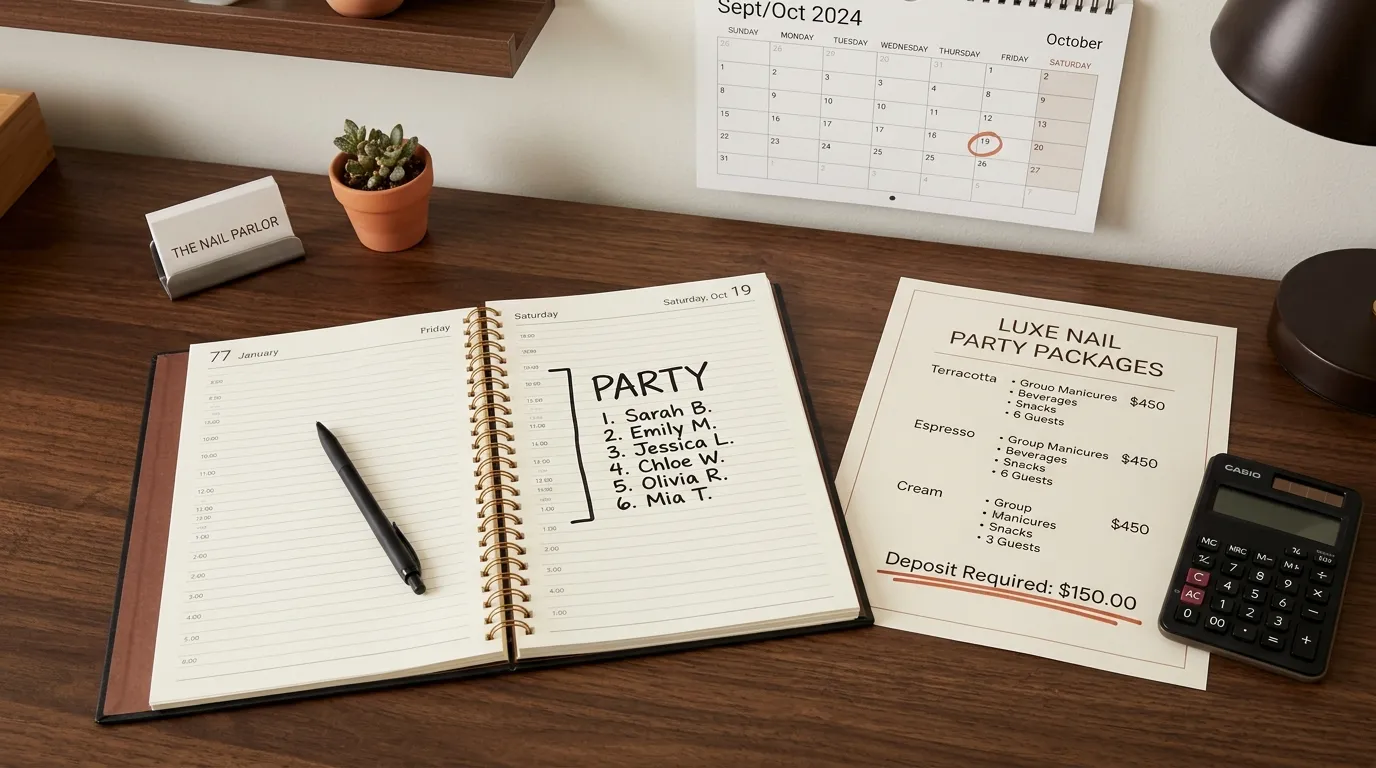
Group bookings are the easiest revenue a nail salon quotes wrong. Quote the menu price times the headcount and the caller balks. Discount the block to win the booking and the margin disappears. Nail salon party packages fix both outcomes, but only when the pricing, deposits, staffing, and calendar rules are written down before the first inquiry arrives.
Group Nail Appointments Pricing: Set the Floor First
A party is a bundle with a price of its own. Zenoti’s salon pricing guide reports that bundled services run 10 to 15 percent below menu prices and that mani-pedi combos carry the best dollar-to-time ratio in the industry. Apply that range to the group and stop there.
Run the math on a real party. Six guests, each booking a gel manicure at the $35 to $60 US average from the same Zenoti report. At $50 a head, the block is $300 at menu. A 15 percent bundle discount puts the party at $255, or $42.50 per person. The group saves, and the salon still clears the same margin structure as a normal service hour, because the bundle discount is absorbed by the volume of the block.
Set two numbers before you publish anything: a minimum headcount and a per-person rate. Multi-location chain Nail Garden requires a minimum of four guests for group booking. A four-guest floor is the industry standard for a reason: below that, the bundle stops being a party and becomes a plain discount. For a smaller group, quote regular services and skip the bundle.
The Bridal Party Nails Package: Book It Early, Price It Tight
The bridal party is the highest-value group booking a salon can take, because the calendar is set months in advance and the spend per head is high. Party pricing research puts mid-range bridal party manicures at $45 to $120 per person, with gel at $45 to $65. A bride plus five bridesmaids at $60 per gel service is $360 before the bundle. Apply the 15 percent rule and the bridal party nails package prices at $306 for a two-hour block.
Bridal groups book three to six months out, which makes them the cleanest revenue on your calendar. Require the bride to hold the date with a deposit, because a bridal party that loses two members two weeks out leaves you holding three empty chairs on a Saturday. Offer the bride a trial service two to four weeks before the event so the color and design decisions happen before the group arrives, not during it. Brides who want to cover the party for their bridesmaids can prepay with gift cards, which moves the cash before the service and keeps the block paid even if someone drops.
Nail Party Ideas for Salons That Protect the Schedule
The purpose of a party is to fill a slot the regular book does not want. Piling onto the slot that is already full is where the revenue math breaks. The three formats below all follow that rule.
Birthday nail party packages belong on weekday afternoons. Two hours, four to eight guests, one service choice per guest, a price per head that covers the tech time and the cleanup. A Tuesday 2:00 p.m. birthday party of six at $35 a head is $210 of new revenue in the deadest block of the week.
Corporate and team events take Monday and Tuesday mornings, when the book is thinnest. One service, a fixed start, a single invoice. Companies pay deposits without argument because they book against a budget.
Girls’ night out and bachelorette groups fit Thursday evenings, when walk-in traffic is light and a two-hour block does not cost you a full Saturday.
The rule is the same across all three: off-peak placement is the product. If a group insists on Saturday morning, quote the party at the full menu total with no bundle discount, because the bundle discount is what buys you the off-peak slot.
Prom Nail Appointments for Salons: Block the Surge
Prom season is a six-to-eight-week surge from late March through mid-May, and it arrives in groups of four to ten students with an average spend of $350 to $750 per group. The booking rush starts two to three weeks before each school’s prom night. That is your planning window, and it closes fast.
Prom nail appointments for salons work when the slots are pre-blocked. Open prom bookings eight weeks out, cap the number of groups per day at what your chairs can actually serve, and collect a per-student deposit at booking. When prom groups book through the same channels as regular clients, the surge becomes scheduled revenue instead of a scramble. The same block-and-staff discipline that carries the holiday season prep plan applies here: decide the capacity, publish it, and refuse the overflow.
Staffing and Deposits: The Rules That Keep Parties Profitable
Two logistics questions decide whether a party makes money: how many techs, and what happens when the group shrinks.
The tech-to-guest ratio depends on the service. One tech handles one guest for gel or acrylic services, which run 45 to 90 minutes each. One tech can manage two guests for a polish-change party, where the service runs 20 to 30 minutes. A six-guest gel party needs three techs and roughly two hours. If you have two techs, run the party in two waves of three and quote a four-hour block. Chair rotation is a selling point: the group stays together, nobody waits for an empty seat, and the party becomes the event the organizer wanted.
The deposit is non-negotiable for groups of four or more. Nail Garden holds group bookings with a 25 percent deposit and a seven-day cancellation window. California chain GLO Nail Bar runs the tighter version: a $10 per person deposit for groups of five or more, a $100 per person minimum for groups of eight or more, and full deposit forfeiture inside 72 hours. Either structure works. No deposit, no party booking, because the deposit is what pays the techs you scheduled against the block.
Common Mistakes That Turn Party Profit Into a Loss
The mistakes are consistent across the salons that lose money on parties.
No minimum headcount. A group of two at a discounted rate is just a discount. Set the floor at four and enforce it.
Waiving the deposit for a group that “seems nice.” The group that balks at a $10 per person deposit is the group that cancels. The deposit is the filter.
Booking parties into the Saturday peak. A party that displaces three full-price regulars is a revenue swap that moves money from one part of the day to another. Off-peak or no bundle discount.
Understaffing. Eight guests, two techs, and a four-hour promise is a refund waiting to happen. Match the headcount to the ratio and quote the real time.
No plan for the group that shrinks. The bridesmaid who cancels Tuesday still owes the deposit, and the party price stays on the original headcount. Put that in writing before the deposit clears.
What Success Looks Like
Run the system and the numbers are concrete. One bridal party a month at $306 is $3,672 a year. One prom group per weekend through the April surge at $500 average is another $2,000. Two weekday birthday parties a month at $210 each is $5,040. Total: over $10,700 a year from appointments that never touch the Saturday book.
The parties also feed the regular book. Every guest who leaves with a service she loves is a client who can be brought back with the client retention strategies that keep rebooking rates up. The deposit covers the risk, the off-peak placement covers the schedule, and the party becomes the rare revenue stream that fills chairs without costing you a single regular appointment.