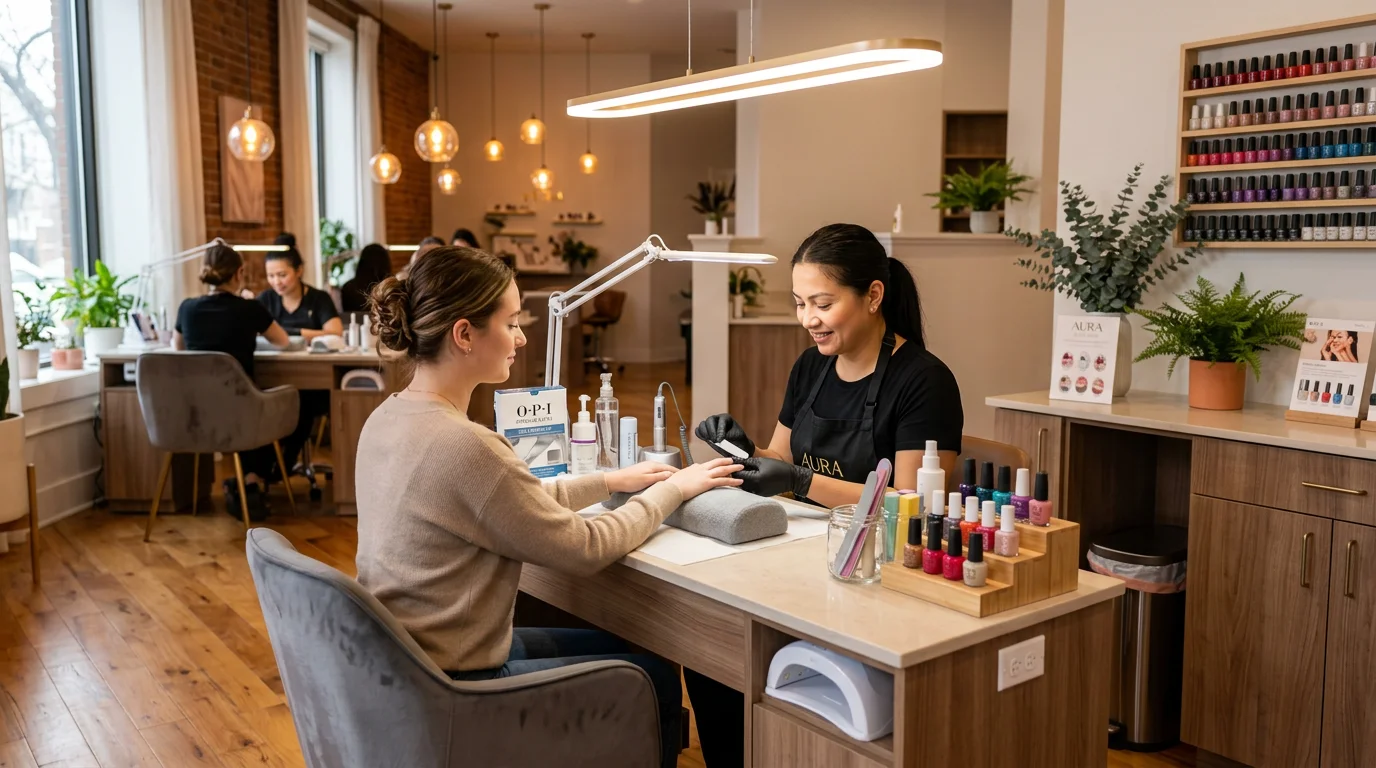
A client picks a dusty rose gel from your swatch wheel. You apply it under warm overhead bulbs. She walks outside, looks at her nails in daylight, and the color reads pink-orange. That mismatch is not a product problem. It is a lighting problem. And it costs you rebookings.
Getting salon lighting right means balancing two goals: color accuracy at the nail station and an atmosphere that feels worth the price tag. Here is how to do both.
Best Color Temperature for Nail Stations
Color temperature, measured in Kelvin (K), describes how warm or cool a light source appears. Lower values like 2700K produce a warm, yellowish glow. Higher values like 6500K lean blue-white.
For nail color matching, you want 4800K to 5500K at the task level. This range mimics neutral midday sunlight and shows polish colors as they actually are. Below 4000K, reds shift orange and nudes look sallow. Above 6000K, colors wash out and skin looks unflattering.
The sweet spot for most nail stations is 5000K. At this temperature, gel polishes, dip powders, and lacquers all render true to their swatch. Your clients see the same color indoors that they will see walking to their car.
What CRI Rating Do Nail Salons Need?
Color Rendering Index (CRI) measures how faithfully a light source reveals the full spectrum of colors compared to natural sunlight. A CRI of 100 is perfect. Most cheap LED panels sit around 70 to 80.
For nail work, aim for CRI 90 or higher. At CRI 80, subtle differences between similar polish shades disappear. That nude pink and nude peach look identical under low-CRI light, but completely different in daylight. High-CRI lighting (95 to 98) is available in professional-grade task lamps and is worth the upfront cost.
If a manufacturer does not list CRI on the packaging, assume it is below 80. Skip it.
Task Lighting vs. Ambient Lighting
Your salon needs two distinct lighting layers, each doing a different job.
Task lighting sits close to the nail and provides bright, focused illumination for detail work. This is where your CRI and color temperature specs matter most. Task lights should deliver 800 to 1,500 lux at the working surface, roughly 30 cm from the lamp head to the nail bed. For intricate nail art, push toward the higher end. A typical office desk gets 300 to 500 lux. Your nail station needs two to three times that.
Ambient lighting fills the rest of the room and sets the mood. Go warmer here, in the 3000K to 3500K range, using recessed ceiling fixtures or indirect LED strips. Ambient light should sit around 300 to 400 lux. Dimmer switches give you flexibility to adjust between daytime and evening appointments.
The key: keep these two layers separate. If your only light source is the overhead ceiling fixture, you are forcing one light to do two contradictory jobs.
LED vs. Fluorescent Lighting for Nail Salons
If your salon still runs fluorescent tubes, here is what you are dealing with. Fluorescents typically offer CRI values between 62 and 80. After 6 to 12 months of daily use, they lose 20 to 30% of their initial brightness and their color rendering shifts. They flicker at 60 Hz, causing eye fatigue during close-up work and visible artifacts in photos and videos.
LED fixtures start at CRI 80 for budget models and go up to 98 for professional-grade options. They hold their brightness for 30,000 to 50,000 hours. No flicker. Lower heat output. Energy consumption runs 50 to 70% lower than fluorescent equivalents. For a salon running 10 hours a day, switching four overhead fluorescent fixtures to LED panels saves $200 to $400 per year in electricity alone.
Recommended Lux Levels for Nail Salons
| Salon Zone | Recommended Lux | Color Temperature |
|---|---|---|
| Nail station (task light) | 800 - 1,500 | 5000K - 5500K |
| Overhead at nail station | 400 - 600 | 4000K - 5000K |
| Reception / waiting area | 200 - 300 | 2700K - 3000K |
| Pedicure area | 300 - 500 | 3500K - 4000K |
| Retail display | 500 - 800 | 3500K - 4000K |
You can verify lux levels at your station with a free smartphone app like Lux Light Meter or a dedicated meter from Amazon for under $20.
Product Recommendations
Real products used in professional nail salons. Prices reflect typical retail at time of writing.
Task Lamps
-
Neatfi XL 2,200 Lumens LED Task Lamp (~$50 to $70). Adjustable arm, 5000K daylight, dimmable, clamp mount. Wide light spread and sturdy arm, with an optional built-in magnifier.
-
Neatfi Half Moon LED Lamp (~$40 to $55). 1,600 lumens, adjustable color temperature from 2500K to 5600K. The half-moon shape throws light evenly across the nail surface without casting hand shadows.
-
Brightech LightView Pro (~$50 to $65). 5-inch magnifying lens, 5000K daylight, flexible gooseneck. Good for techs who do detailed nail art and need magnification plus accurate color.
Overhead Fixtures
-
Barrina LED T5 Integrated Fixtures (~$30 to $40 for a 6-pack). 4000K neutral white, 2,200 lumens per 4-foot tube, CRI 90+. Direct fluorescent replacement that links end-to-end.
-
Hykolity 4FT LED Wraparound Light (~$30 to $35 each). 4,400 lumens, 5000K, CRI 84. Flush ceiling mount for general salon illumination.
Common Nail Salon Lighting Mistakes
Mixing color temperatures in the same zone. If your overhead is 3000K and your task lamp is 6500K, the contrast confuses your eyes. Keep task-area fixtures within 500K of each other.
Positioning the task lamp behind your working hand. This casts a shadow right where you need light. Mount your lamp so it shines from the front or side, not from behind your dominant hand.
Relying on window light as your primary source. Sunlight shifts color temperature throughout the day. A gel that looked perfect at 11 AM reads differently at 4 PM. Use natural light as a supplement and always verify color matches under your controlled task light.
Putting It Together
Start with your task lamp. That single upgrade has the biggest impact on color accuracy and client satisfaction. Choose an LED rated at 5000K, CRI 90+, and at least 1,000 lumens. Clamp it so light falls directly on the nail bed from the front or side.
Next, swap old fluorescent overheads for LED panels in the 4000K to 5000K range. Add ambient accent lighting in the 3000K range for reception and waiting areas. This creates the warm, inviting feeling that justifies premium pricing while your workstations stay clinically accurate.
Good lighting is not a cosmetic upgrade. It prevents callbacks, improves your Instagram content, and makes every polish color look exactly as advertised. For more on creating the right salon atmosphere, see our guide on salon music and ambiance. And if you are setting up a new space, our starting a nail salon guide covers the full build-out checklist.