Fifty-five dollars in a 45-minute slot earns $73 an hour. The same 45 minutes earns $53.30 with a gel manicure in the chair, the benchmark this site’s Gel-X breakdown holds every new service against. Builder gel clears that bar in its cheapest configuration: overlays book at $45 to $65 for 45 to 60 minutes, and product runs $2 to $5 per application. Most operators still file the service under trend and wait. The decision is arithmetic, and the arithmetic has four inputs: what the kit costs, how long certification takes, what a set consumes in minutes and product, and where the price floor sits.
The demand case, in four numbers
Federal Character’s 2025 trend reporting, cited in Lutily’s documentation of builder gel quietly replacing acrylics on salon menus, puts the request rate at 60 percent of clients in salons that carry BIAB. The same piece logs the market behind those requests: more than 480 million TikTok views on BIAB content per Bustle’s tally, a global artificial nails market projected to grow from $1.59 billion in 2025 to $2.72 billion by 2034, and 15 to 20 percent annual BIAB sales growth projected through 2026. The chair-level evidence matters more than the market charts. Lutily’s author watched acrylic bookings fall by roughly a third over a year while the converted clients spent more per visit than they had on acrylics and rebooked every three to four weeks, against the two-week fill cycle acrylic demands. That rebook cadence is the operational difference: builder gel turns the return visit into an infill, a shorter slot that keeps the client in the salon instead of sending her out to grow out a set.
The clients doing the requesting are already in the book. Gel manicure regulars whose natural nails chip or break at two weeks ask for strength. Lapsed acrylic clients who left over the smell and the drill dust ask for the gentler version, and the removal leaves the plate in better shape, which is the nail-health driver behind the request rate. The dip menu math explained why salons added dip: low startup and no lamp. Builder gel costs barely more than a dip launch and adds the structured strength dip cannot deliver, which makes the dip client the third conversion target.
What it costs to add builder gel to your menu
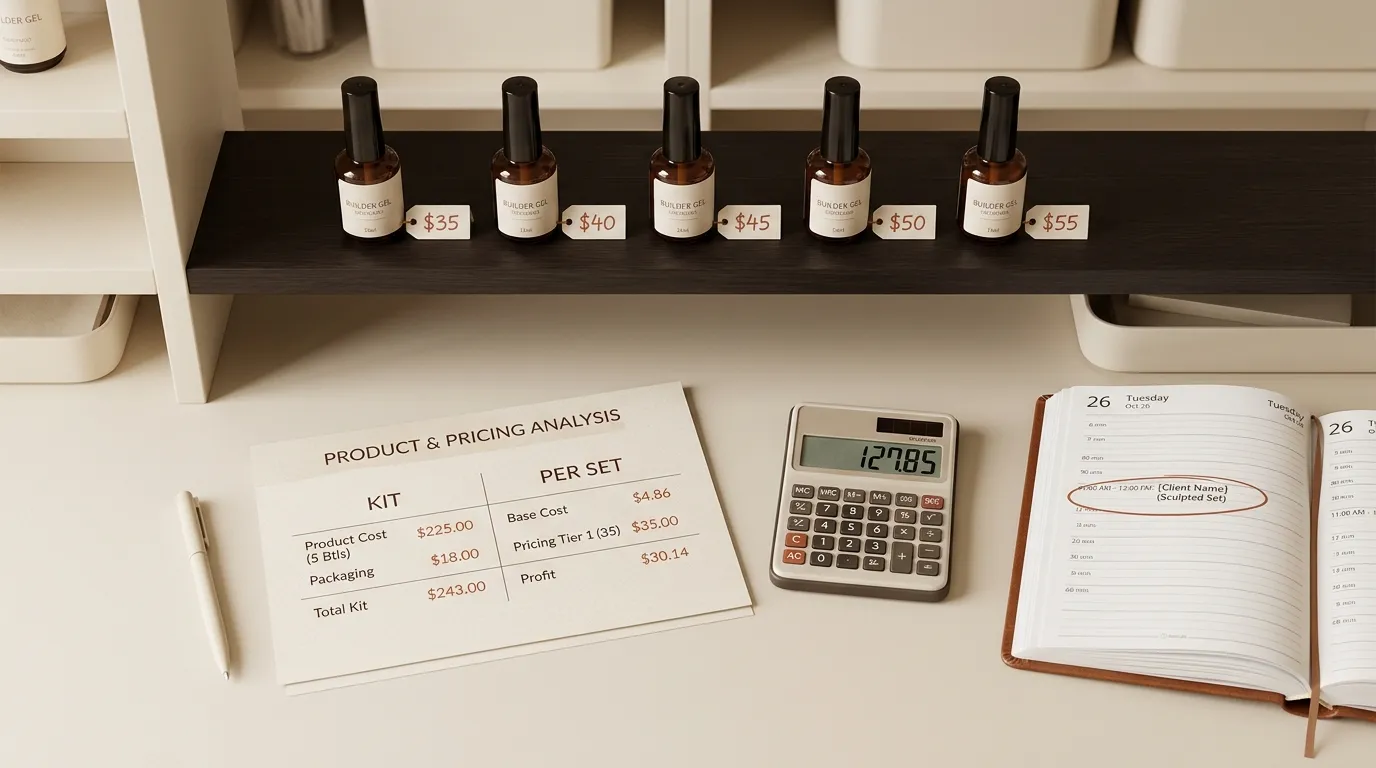
The product is a bottle, and the bottle is cheap. Original BIAB, The GelBottle’s Builder in a Bottle, retails to professionals at $21 per 20ml bottle on the US shop, and the current pick-and-mix prices four bottles at $70. The kits page shows the full retail ladder: best-selling bundles at $80, the natural-shade Bare Edit at $100, the Core Kit at $614, and the Complete Kit at $1,220. A salon launching the service needs three to four bottles, clear plus two coverage nudes, and prep basics most gel menus already stock, so the working entry lands under $250. A salon that wants the shelf stocked buys the Core Kit. Compare the neighbors: the Gel-X rollout ran $500 to $800 with certification, and acrylic demands monomer, ventilation, and a sculpting skill that takes months to build. Builder gel is the cheapest structured service on the supply shelf.
Training is the larger entry cost, and it is measured in hours. The official BIAB course at TGB Academy, the only provider that certifies the brand’s product, runs four hours at £240, about $320, with an optional full starter kit at £440, roughly $580. Entry requires a gel manicure certificate, which most working techs already hold. The syllabus covers overlay application and apex placement, repair and short extension work in Clear BIAB, infills, and safe removal for both soak-off and file-off products, so the class returns a tech who can run the complete service cycle. Add a week of practice sets on models at materials cost, then open a 60-minute slot. The median manicurist wage sits at $17.19 an hour per O*NET’s 2025 data, so the class fee plus practice-week wage-hours land training near $450. Kit, class, and practice together stay under $700 in the conservative case.
The real builder gel service time and cost
An overlay on natural nails runs 45 to 60 minutes. A sculpted builder gel set runs 75 to 90 minutes and books at $80 to $100+. Product consumption stays at $2 to $5 a set, per the industry pricing data in Lutily’s revenue section, because the overlay uses grams of builder gel where a Gel-X set consumes a tip for every finger. The clock translates to the chair like this:
| Service | Chair time | Typical price | Hourly yield |
|---|---|---|---|
| Gel manicure | 45 min | $30-45 | $40-60 |
| Builder gel overlay | 45-60 min | $45-65 | $45-87 |
| Builder gel set, sculpted | 75-90 min | $80-100+ | $53-80 |
| Gel-X full set, trained | 45-60 min | $65-85 | $65-102 |
| Acrylic full set | 60-90 min | $55-100+ | $44-67+ |
The bands come from Boulevard’s 2026 nail price benchmarks, which put gel manicures at $30 to $45 and acrylic extensions at $30 to $100+, and from Lutily’s working-station numbers, where the $55 overlay earns $73 an hour against $45 an hour for a $45 acrylic set over 60 minutes.
Builder gel vs gel-x and acrylic at the chair
The systems answer different complaints. The client typing builder gel vs gel-x into a search bar wants length; the client asking for BIAB wants her own nail back, stronger. Gel-X delivers length with factory-shaped tips and returns as a soak-off and a fresh set, because soft gel tips are designed to be replaced instead of refilled. Acrylic builds rigid structure by hand and still owns the long, custom-shape client. Builder gel adds strength and modest length on the natural nail and returns as an infill, so the client’s investment compounds instead of restarting. The salon’s gel-versus-acrylic framework routes the structure decision client by client; builder gel gives that framework a middle answer it never had. Lutily’s log puts the hourly contrast in one line: $55 in 45 minutes for the overlay, $45 in 60 for the acrylic set.
BIAB pricing for salons that protect the fill cycle
Price against the clock, then check the result against the menu. The floor rule is the same one the pricing guide builds from product, labor, and overhead: price divided by minutes, times 60, has to beat what the chair already earns. At a $40 gel manicure in 45 minutes, that floor is $53.30 an hour. The overlay clears it at $55 for 45 minutes ($73) and at $60 for 50 ($72). It fails at $45 for 60 slow minutes ($45), which is the configuration that actually cannibalizes the menu: the service exists, the client books it, and the chair earns less than it did with the manicure she used to book.
The fill cycle sets the ceiling on discounting. Builder gel holds three to four weeks, so a converted client’s year is 13 to 17 visits alternating a $55 overlay with a $30 to $45 infill in a 30 to 45-minute slot, positioned in the top half of Boulevard’s $20 to $45 acrylic infill band. Each infill preserves the overlay’s hourly while pricing under it. Two disciplines hold after launch. Bill the removal separately, because a soak-off takes 15 to 20 minutes of acetone wrap before the infill even starts. Sell hand care deliberately, because the appointment already reads as an investment and bundles push tickets 20 to 30 percent above the base service, per the industry data Lutily cites. The acrylic book stays untouched. The service pulls from the request list, the lapsed list, and the upsell conversation, and it converts those at $66 to $73 an hour instead of the $53.30 the same chair earns on the manicure menu.
The math that lands the slot
Kit under $250, class four hours, launch under $700, floor $53.30: builder gel is the cheapest structured service a salon can add, and the only way it loses money is the way every service loses money, a price set against the neighbors on the menu instead of the clock.