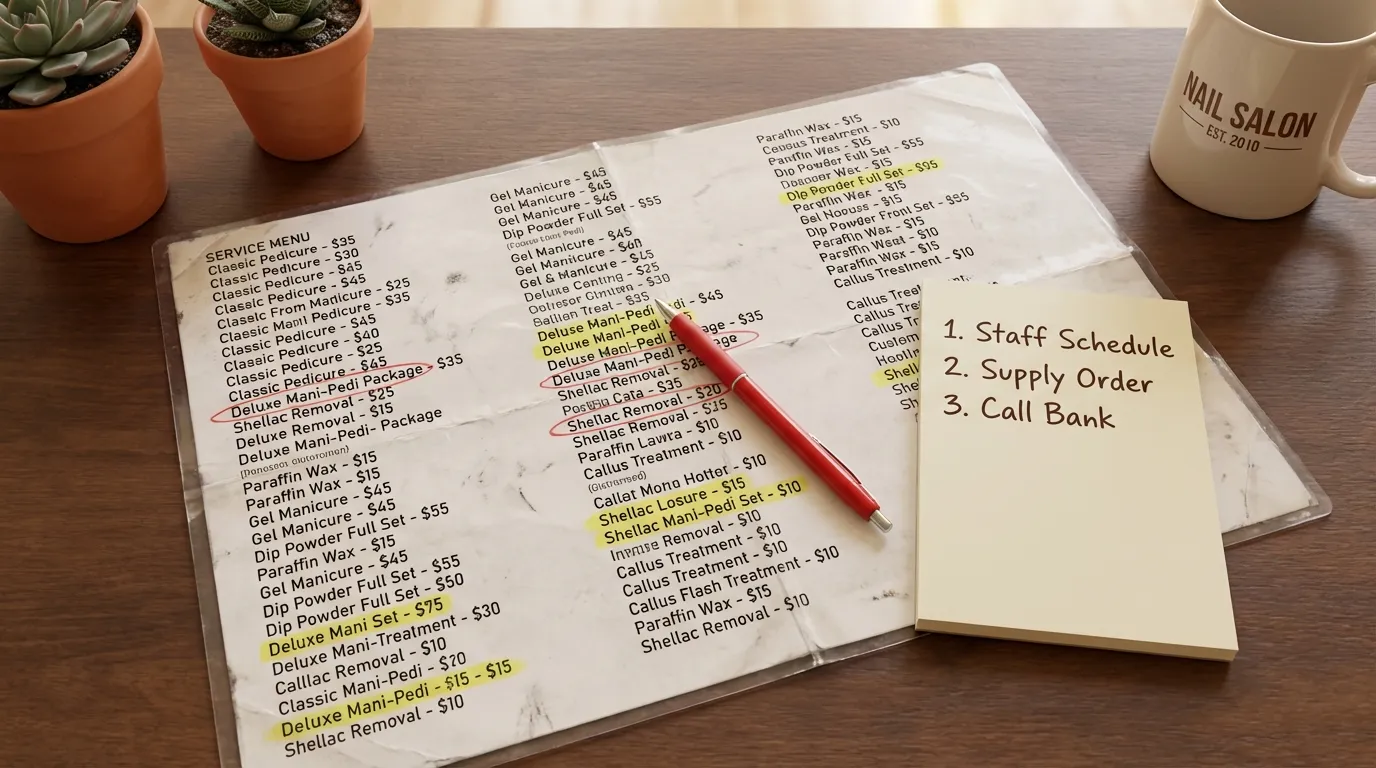
Every nail salon owner has had the same instinct: add more services, attract more clients. Chrome nails are trending, so add chrome. Dip powder is hot, so add three tiers of dip. A competitor offers paraffin add-ons, so you match them. Within two years, your service menu reads like a diner menu. Forty-plus line items. Twelve variations of a manicure.
The logic feels airtight. More options, more revenue. The data says otherwise.
The Jam Study and Your Service Menu
In 2000, psychologists Sheena Iyengar and Mark Lepper ran an experiment at a grocery store. One display offered 24 varieties of jam. Another offered 6. The large display attracted more browsers, with 60% of shoppers stopping to look. But only 3% bought. The small display drew 40% of passersby and converted 30% of them to buyers.
A tenfold difference in conversion from cutting options by 75%.
This pattern holds outside grocery stores. HubSpot found that consolidating their pricing tiers lifted conversions by 112%. Zoho trimmed CRM pricing from five tiers to three and saw trial-to-paid conversions jump 17%.
Nail salons are not SaaS companies. But clients scanning a 40-line service menu face the same cognitive load as someone staring at 24 jam flavors. They default to the cheapest option they recognize, or they ask, “What do you recommend?” Either way, the menu failed to do its job.
What a Bloated Menu Actually Costs
The visible cost is confusion at the front desk. The hidden costs are worse.
Product inventory expands. Every new service adds SKUs. Chrome powders, specialty base coats, builder gels, dip liquids, paraffin wax. Salons typically spend 8 to 12% of revenue on supplies, but poorly managed inventory inflates that by 20 to 35% through overstock and expiration. If you carry products for 40 services and 15 of them get booked twice a month, those supplies sit. They expire. They tie up cash that could go toward products you actually move.
Training load multiplies. A tech who needs to be proficient in 12 service types takes longer to onboard and longer to reach consistent quality. Standardized service times become impossible. One client’s “gel manicure” takes 45 minutes; another tech’s version takes 65. Scheduling falls apart.
Pricing gets murky. When you have dozens of services, pricing each one correctly requires tracking material costs, time costs, and margin targets for every line item. Most owners stop doing that math after the first ten. The rest get priced by gut, and gut tends to undercharge.
What the Numbers Say About Fewer Services
The restaurant industry figured this out years ago. Research by food industry analyst Panitz showed that 60 to 70% of sales come from fewer than 18 to 24 menu items, regardless of total menu size. The rest is noise that costs money to maintain.
Nail salon data tells a similar story. Financial Models Lab benchmarks average nail salon transactions at around $106, with add-ons and retail contributing roughly $20 of that. The high-margin services, the ones pulling gross margins above 60%, tend to cluster in a handful of categories: gel extensions, structured manicures, and specialty pedicures.
A salon running six core services with two or three strategic add-ons can hit the same average ticket as a salon listing 35 services. The difference: lower inventory costs, faster training, tighter scheduling, and clients who actually understand what they are buying.
How to Trim Without Losing Revenue
Cutting services feels risky. Here is how to approach it without guessing.
Pull your booking data. Look at the last 90 days. Rank every service by frequency. Anything booked fewer than four times a month is a candidate for removal. If you added dip powder last year and it books 15 times a month, it stays. If a specialty pedicure variant books twice, it goes.
Consolidate variations. You do not need “Classic Manicure,” “Deluxe Manicure,” “Spa Manicure,” and “Signature Manicure.” Three tiers at most: a base service, a mid-tier with clear upgrades, and a premium with defined add-ons. Name them plainly.
Move add-ons to the chair. Nail art, paraffin, extended massage. These work better as upsells during the appointment than as separate line items cluttering the menu. The tech suggests them when relevant. The client says yes more often because the context is right.
Recheck pricing on what remains. Fewer services means each one needs to carry its weight. Recalculate material cost, time, and margin for every item that survives the cut. Price it correctly.
Fewer Lines, Sharper Business
A nail salon with 10 well-priced services and 4 add-ons will outperform a salon with 40 scattered offerings on nearly every operational metric: inventory turns, tech efficiency, average ticket, and client satisfaction. The menu is not a catalog. It is a decision tool. The fewer decisions it forces, the faster clients book the service you actually want to sell.