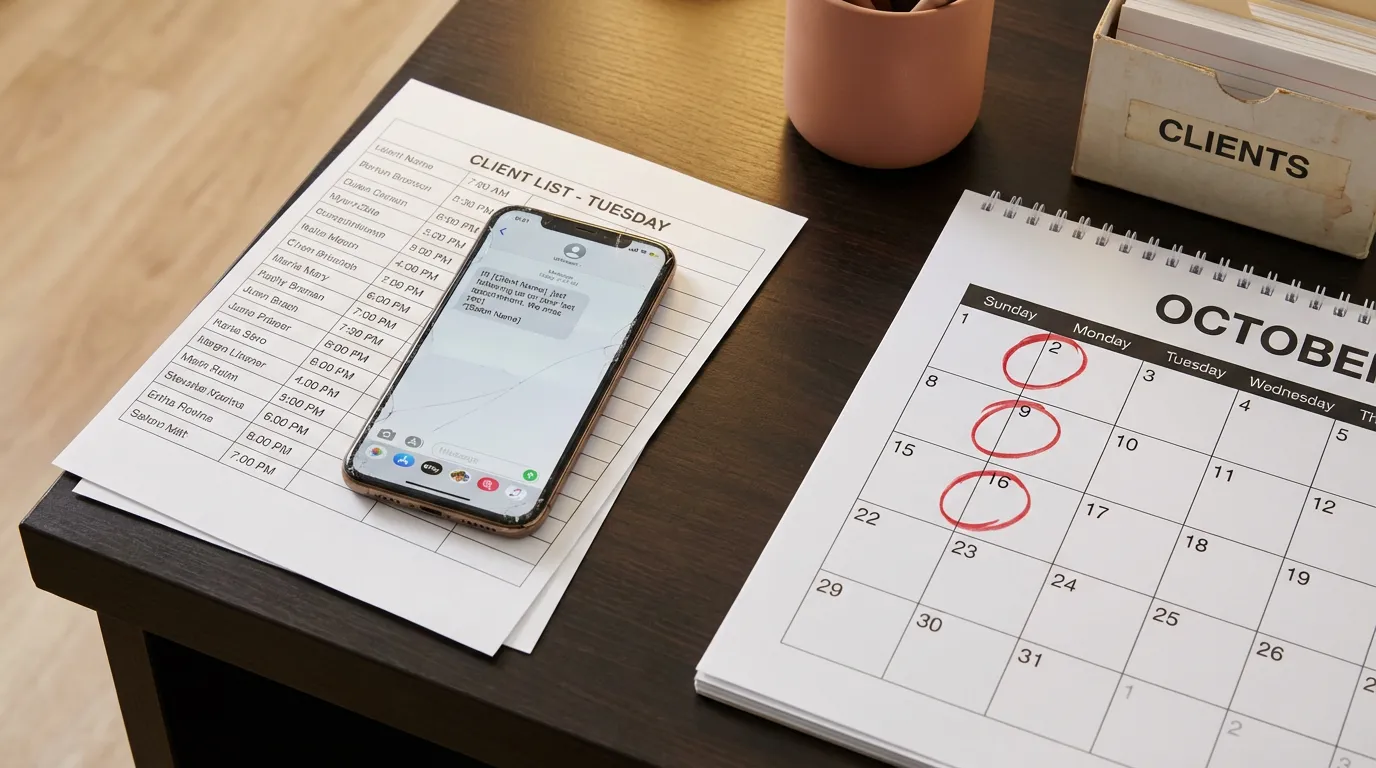
Most nail salons lose between 25 and 40 percent of their active client base every year through pure attrition, according to industry reactivation data compiled by AI Agents Plus. For a salon with 400 active clients spending an average of $800 a year, that is roughly $80,000 to $128,000 walking out the door annually. None of those clients are angry. Most of them have just moved on, lost the salon’s number, or fell out of routine.
The work of bringing them back is not sales. It is sequencing. Below is the operational version: how to identify the right clients, what to send, when to send it, and what to expect for response rates.
Define what “lapsed” actually means for your salon
Before any outreach, set a number. A client is not lapsed because you feel like you have not seen them. A client is lapsed because they have crossed a defined service interval without rebooking.
The general rule for manicures is every two to three weeks, as outlined in this guide from The Nail Bar. Pedicures stretch to every four to six weeks. Build your lapsed window from the service:
- Gel and dip clients: lapsed at 6 weeks since last visit
- Regular polish manicure: lapsed at 5 weeks
- Pedicure-only clients: lapsed at 8 weeks
- Combo manicure plus pedicure regulars: lapsed at 7 weeks
Research in the Journal of Database Marketing is plain about this: the lapsed definition has to match the natural purchase cycle. Reach out too early and you sound needy. Too late and the client has locked in a new salon.
Pull the list and segment it
Export every client whose last visit falls in the lapsed window plus the next 12 weeks. If your gel window is six weeks, your reactivation list runs week six through week eighteen since last visit. Anyone older than four months is a separate, colder list.
Segment into three buckets:
- Recently lapsed (1 to 6 weeks past due). Highest return probability. They probably just missed a booking.
- Mid-lapsed (6 to 12 weeks past due). Habit is broken. Needs a stronger nudge.
- Cold (3 to 6 months past due). Treat as semi-acquisition. Different message, different incentive.
Strip out anyone who opted out of marketing texts, anyone with a recorded complaint, and anyone you fired. The cleanup matters more than the message.
Get nail salon text message marketing consent right before you send
Under the TCPA, marketing texts require prior express written consent. Verbal consent does not count. A client handing over their number to book counts as consent for transactional messages like reminders, but not for promotional outreach. The April 2025 TCPA opt-out rules also tightened the response window: you have to honor opt-outs within 10 business days, and clients can opt out through any reasonable method, not just texting STOP. Penalties run from $500 to $1,500 per violation.
If your intake form does not have an unchecked box reading “Yes, send me appointment offers and promotions by text,” fix that today. Then only message clients who actually opted in. Everyone else gets an opt-in invitation first.
Write the salon SMS win-back message and time it right
Send during business hours, Tuesday through Thursday, between 10 AM and 2 PM. Avoid Mondays (full inbox) and Fridays (checked out). Keep messages under 160 characters. SMS open rates run near 98 percent and response rates near 45 percent versus 10 percent for email, per OptiMonk’s 2026 SMS marketing benchmarks. You do not need clever copy. You need short, specific, and personal.
Recently lapsed (1 to 6 weeks)
Hi [Name], it’s [Salon]. Looks like you’re due for a fill. We have Wed 2pm or Thu 11am open this week. Reply YES and we’ll book you. - [Tech Name]
No discount. No urgency theater. Reads like a real reminder because it is one. Recovery rates here typically run 25 to 35 percent.
Mid-lapsed (6 to 12 weeks)
Hi [Name], it’s [Tech] at [Salon]. Haven’t seen you in a bit and wanted to check in. If you’d like to come back, here’s 15 percent off your next service through [date]. Book here: [link]
Naming the technician matters. Phorest’s salon SMS data shows that mentioning the specific stylist drives recovery rates of 18 to 25 percent on this segment. Generic “we miss you” messages from a faceless salon do half as well.
Cold (3 to 6 months)
Hi [Name], it’s [Salon Owner Name]. I noticed you haven’t been in since [month]. If something went wrong, I want to know. If life just got busy, here’s $20 off your next visit when you rebook by [date]: [link]
This is the only message where you offer real money. Keep the tone honest. Some of these clients left over a service issue you never heard about. The replies are worth the discount even if no one books.
Follow the booking with an aftercare sequence
Reactivation is not a one-shot. Once a lapsed client shows up again, the goal is to keep them from going lapsed twice. The highest-leverage move is a same-day or next-day post-visit text with care instructions and a rebook link. A well-timed aftercare text does most of the retention work for you, as Lutily’s team laid out in their playbook on aftercare texts that drive retail and rebooking. It takes 30 seconds to template and turns a return visit into a habit.
Pair it with a calendar-based rebook nudge at the four-week mark. Do this for every reactivated client and you cut your future lapse rate roughly in half.
Common mistakes that kill response rates
- Sending from a five-digit short code. Use your salon’s main line. Short codes read as spam.
- Discounting from the first message. A coupon to a client who simply forgot to book trains them to expect discounts. Lead with availability, not money.
- Blasting the whole list at once. Stagger sends across three to five business days. Twelve booking replies landing in 20 minutes mid-service is how you lose them again.
- Ignoring the no-reply. One follow-up after 10 to 14 days, then stop. Two messages is professional. Four is harassment.
- Not tracking what works. Note recovery rate per segment. If cold converts at 8 percent and mid-lapsed at 22 percent, you know where to spend your next hour.
What success looks like
Run this sequence quarterly. Expect 15 to 25 percent recovery overall, with the bulk from the recently lapsed bucket. On a 300-name list, that is 45 to 75 returning clients per quarter. At an average $65 ticket, that is $2,925 to $4,875 in recovered revenue per cycle, against maybe two hours of front-desk time.
Industry retention research shows it costs 5 to 25 times more to win a new client than to bring back a lapsed one, per Zenoti’s salon retention guide. The math on reactivation is not close.
For the broader retention play this fits inside, see the walkthrough on client retention strategies for nail salons and the breakdown of what each no-show actually costs your salon. Reactivation only matters if you also stop the leak at the front of the funnel.