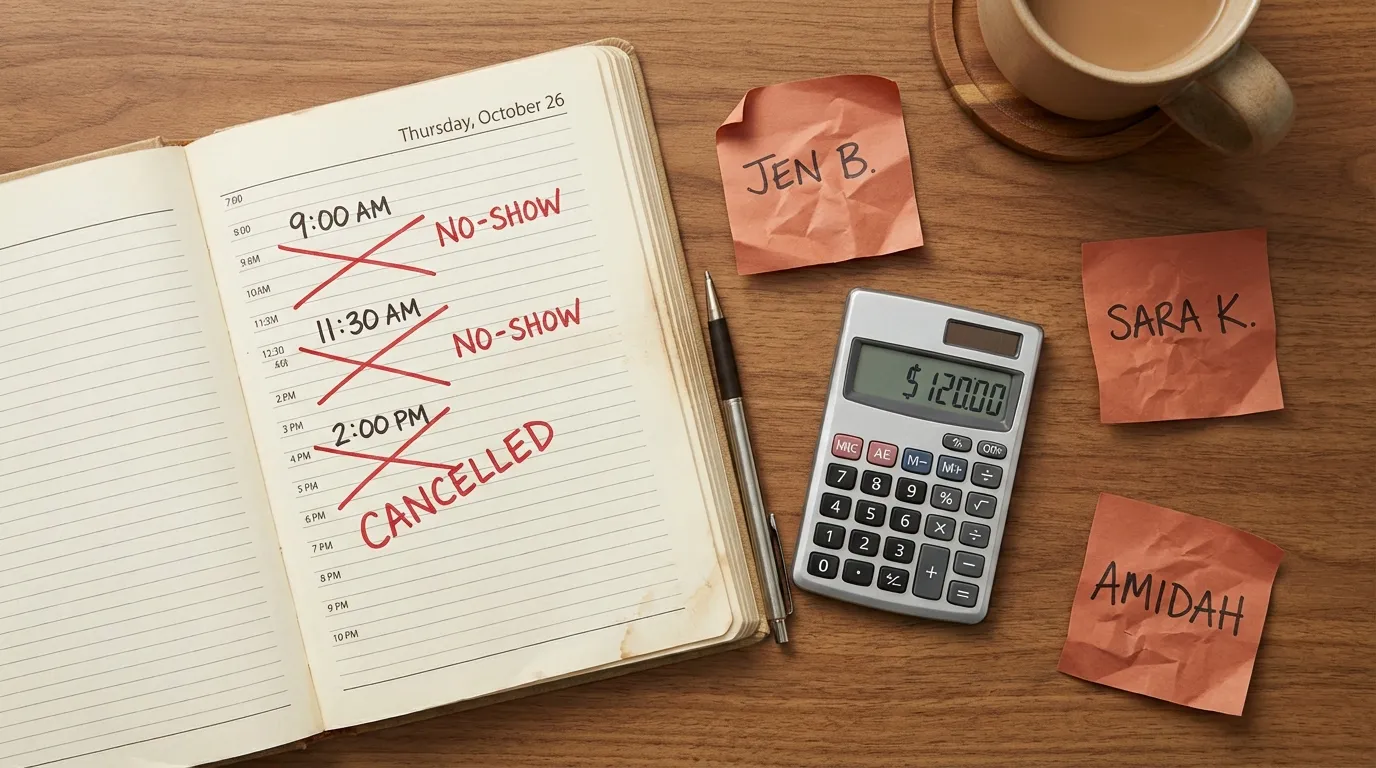
$480 per week. That is what a 4-chair nail salon loses to no-shows at a 15% rate and a $53 average ticket, according to analysis from Simple Salon. Annualized, the figure lands between $24,000 and $31,000. For a business with net margins of 10-17%, that gap can be the difference between profit and break-even.
Most salon owners think of a no-show as one missed appointment. The real damage is wider than the empty chair.
What a Single No-Show Actually Costs
The visible cost is straightforward: one skipped appointment at $53 (the national average mani-pedi combo in 2025, per Zenoti’s pricing guide) means $53 in lost revenue. But the invisible costs compound.
Labor. Your tech is on the clock whether a client shows up or not. If you pay hourly or salary-plus-commission, that idle 45 to 75 minutes still costs you $12 to $18 in wages. Commission-only structures shift the loss to the tech, but the salon still absorbs overhead for that slot.
Turned-away clients. A booked slot that goes empty could have been filled by a walk-in or a waitlisted regular. Every no-show is a double loss: the client who did not come and the client who could not get in. If your salon runs an appointment-only model, the opportunity cost is higher because there is no walk-in traffic to absorb the gap.
Product waste. If your tech prepped a soak bowl, mixed monomer, or set out gel colors before the client failed to appear, those materials are gone. Small per-incident, but it adds up across a year.
Morale. Techs who get no-showed repeatedly lose motivation and income. In commission-heavy shops, chronic no-shows push good technicians to look for chairs at busier salons. Turnover costs more than empty slots.
A conservative estimate: each no-show costs the salon 1.3 to 1.5 times the service price once you factor in labor, lost opportunity, and overhead. A $53 appointment that does not happen costs you closer to $70 to $80 in real terms.
How to Calculate Your Salon’s No-Show Rate
The formula is simple, and you should be tracking it monthly:
No-show rate = (missed appointments / total booked appointments) x 100
Goldie’s scheduling research found that the beauty industry average sits between 10% and 20%. Nail salons tend to land on the lower end of that range, partly because service durations are shorter and clients book closer to their appointment date. But even a 10% rate eats real money.
Here is the math for a typical 4-chair salon:
| Metric | Value |
|---|---|
| Techs | 4 |
| Clients per tech per day | 6 |
| Working days per week | 5 |
| Total weekly appointments | 120 |
| Average ticket | $53 |
| Weekly revenue at full book | $6,360 |
| At 10% no-show rate | |
| Missed appointments per week | 12 |
| Lost revenue per week | $636 |
| Lost revenue per year | $33,072 |
| At 15% no-show rate | |
| Missed appointments per week | 18 |
| Lost revenue per week | $954 |
| Lost revenue per year | $49,608 |
Those numbers assume direct revenue loss only. Factor in the 1.3x multiplier for true cost and a 15% no-show rate puts you at roughly $64,000 in annual damage. That matches Salon360’s finding that beauty businesses lose an average of $67,000 per year to missed appointments.
Deposits and Cancellation Fees Reduce No-Shows
The single most effective countermeasure is a deposit policy. Shortcuts Software data shows salons requiring deposits see no-show rates drop by 29% to 70%. GlossGenius reports a 32% increase in completed appointments among salons that implemented card-on-file deposits.
The standard deposit structure for nail salons:
- Flat deposit: $20 to $25 for standard services, $40 to $50 for long appointments (full sets, nail art). Applied to the final bill.
- Percentage deposit: 50% of the service cost, collected at booking. This is more common for high-ticket services.
- Card on file: No upfront charge, but the client agrees to a cancellation fee (typically 50% of service cost) if they no-show or cancel within 24 hours.
The concern most owners raise: deposits will scare clients away. The data does not support that. Salons that implemented deposits through GlossGenius saw not just fewer no-shows but a 30% increase in average spend from the clients who did book. Committed clients spend more.
Automated Reminders Cut No-Shows Further
Text message reminders have a 98% open rate. Sending one 24 hours before the appointment and a second one hour before reduces no-shows from the 10-20% range down to roughly 5%, according to Vocaly AI’s scheduling analysis.
The math on that shift is worth seeing. Take the same 4-chair salon from the table above at a 15% no-show rate:
- Before reminders: 18 missed appointments per week, $954 lost
- After reminders (5% rate): 6 missed appointments per week, $318 lost
- Weekly recovery: $636
- Annual recovery: $33,072
A booking platform that sends automated SMS reminders typically costs $25 to $50 per month. The return is not even close. If your scheduling system does not include automated reminders, the cost of switching is paid back within the first week.
Combine Both for Maximum Recovery
Deposits alone cut no-shows by up to 70%. Reminders alone cut them by about 67%. Together, salons routinely push their no-show rate below 3%.
At 3% on 120 weekly appointments, you lose 3.6 appointments per week instead of 18. The difference is $763 per week, or $39,676 per year, back in your pocket.
The operational playbook: require a card on file at booking, send a 24-hour text reminder, send a 1-hour text reminder, and charge a 50% fee for no-shows. Communicate the policy clearly at booking. Post it on your website and in your salon. Clients who respect your time will not push back. Clients who do push back were going to no-show anyway.
A $53 empty chair is not a minor inconvenience. Multiplied across a year, it is the salary of a part-time receptionist, a quarter’s worth of product restocking, or the deposit on a second location lease. The fix costs less than $50 a month. The only expense is deciding to implement it.