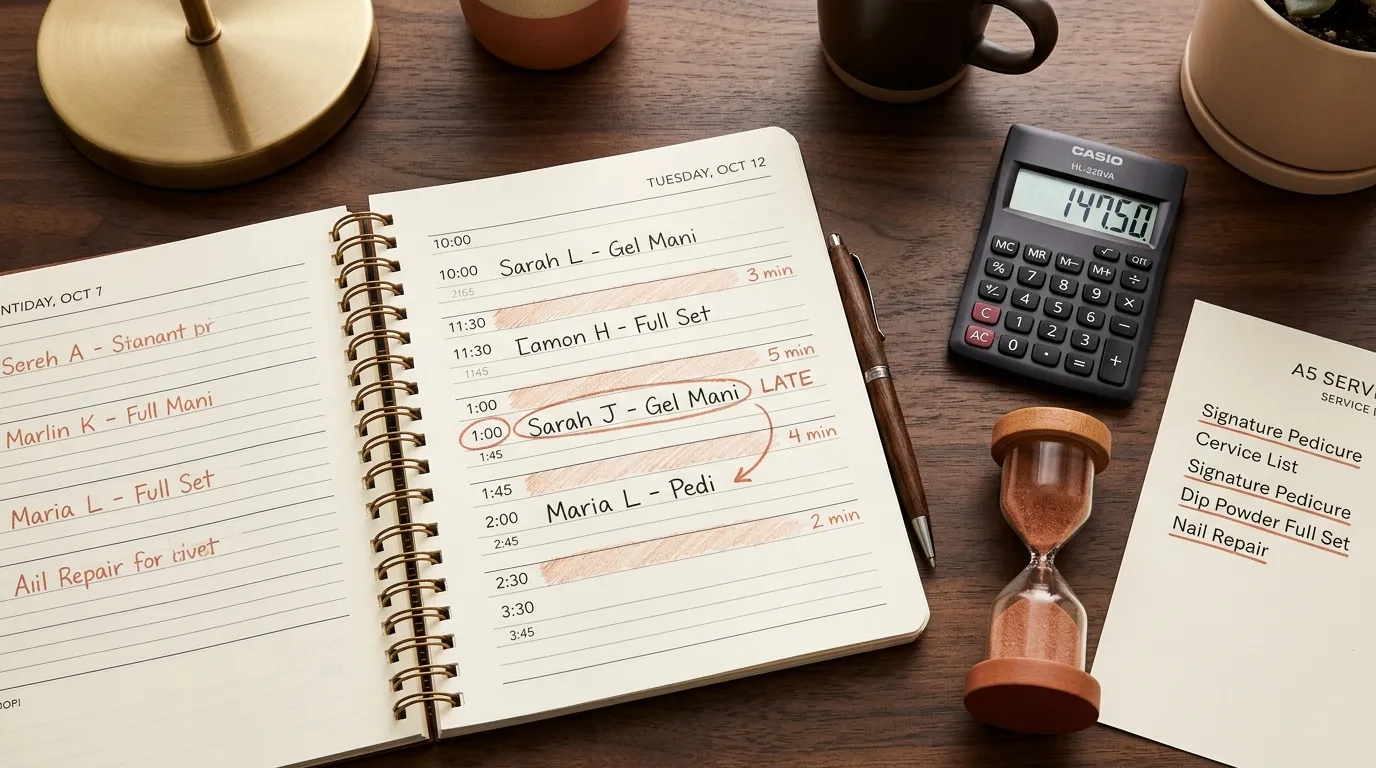
Forty-five percent of salon clients name waiting around for their appointment as their single biggest frustration, according to Zenoti’s 2024 salon and spa consumer survey. Nail clients rarely remember which service ran long. They remember the lobby chair at 11:40 when the book said 11:15. In a packed salon that wait usually starts as a ten-minute overrun at 9:30 that nobody absorbed, and it compounds quietly until the mid-afternoon clients are half an hour behind. Buffer time between appointments is the operational fix, and the fix is mostly arithmetic: how many minutes each service needs in reserve, and where those minutes sit in the day.
What One Overrun Costs a Booked Day
Trace a morning with no gaps. A gel fill booked 10:00 to 10:45 runs to 10:57. The 11:00 pedicure starts twelve minutes late and, because pedicures vary more than fills do, finishes eighteen past its slot. The 12:30 full set inherits thirty minutes of debt before the first tool comes out of the drawer. Nothing dramatic happened. Two services ran a little long, as services do, and a zero-gap calendar transferred every one of those minutes to the next client.
By close, the delay has stacked past the point where hustle recovers it. The tech shortens the final set to catch up, the client notices, and the review mentions the rush instead of the work. Lutily’s salon-wide analysis of schedule overruns puts the cost of this pattern at $2,000 to $5,000 a month for the average U.S. salon, with most of the damage traced to cascading delays rather than to any single appointment that ran over. Hold the tickets against it: Boulevard’s 2026 nail price benchmarks put a gel manicure at $30 to $45 and a spa pedicure at $35 to $65, so a day of four delayed clients, two rushed services, and one regular who leaves annoyed erases the margin on a week of fills.
Salon Buffer Time by Service: The Formula
The question of how much time between salon appointments is enough has a per-service answer, because three costs stack up differently between clients.
Station reset is sanitation and setup: fresh file, new liner, tools out for the next client. Five minutes minimum, ten when a pedicure chair is part of the turnaround.
Overrun risk is the variance in the service itself. A gel fill on a regular is the most predictable slot on the menu. A new set with nail art is the least.
Turnaround covers checkout, rebooking at the desk, and walking the next client to the chair.
Added up, the formula lands per service like this:
| Service | Booked slot | Buffer | Real interval |
|---|---|---|---|
| Standard manicure | 30 min | 10 min | 40 min |
| Gel fill | 45 min | 10 min | 55 min |
| Spa pedicure | 60 min | 10 min | 70 min |
| Acrylic or gel full set | 75-90 min | 15 min | 90-105 min |
| Full set with art, or combo | 105-120 min | 20 min | 125-140 min |
The industry converges on similar numbers from the other direction. Dingg’s U.S. salon scheduling guide recommends a 15-minute buffer after every color service and any appointment booked longer than 45 minutes, because those slots carry the widest variance. Translated to a nail menu: everything 45 minutes or longer gets a gap, and the fill-versus-new-set split decides whether it is 10 or 20.
Buffer Time Between Nail Appointments: Where the Gaps Go
Placement follows four rules.
- Buffers sit after services, never before. The client books 11:00 and arrives at 11:00; only the calendar knows the next real start is 11:55. Booking software with per-service buffer settings enforces the gap invisibly. Salons that pad the service duration instead show clients a 55-minute fill and invite the question of what takes so long.
- The largest gaps go around the highest-variance services. Twenty minutes after a 105-minute art set absorbs its worst-case overrun. Ten minutes after a fill absorbs cleanup, which is all it needs to.
- One hard reset goes at the lunch edge. Whatever the morning did, the first afternoon slot starts clean: 15 to 20 minutes between the last morning service and the 1:00 booking breaks the drift before it compounds into the second half of the day. On a full book, this single placement does more work than any other.
- Nothing follows the last appointment. A buffer after close is wasted inventory. The final slot can absorb whatever overrun the day produced.
The cost side needs stating. Six services at an average 12-minute buffer returns about 70 minutes of chair time per day, close to 15% of an eight-hour chair day. That is the real price of the system, and it shapes where buffers belong. A book running at full utilization pays the 70 minutes and gets its schedule back. A book with chronic empty slots should hold off on blanket buffers, because a buffer is a controlled pause between paid services while an empty slot is unbooked time, the problem a standby list that fills same-day cancellations exists to solve. Across a multi-chair floor the same math applies per tech, and the shift-template structure behind a multi-tech schedule is what keeps those per-chair buffers from colliding at the front desk.
When the Client Is the Late One
Buffers absorb services; the grace policy handles arrivals. Salon-policy guides converge on a 10-to-15-minute grace window, and the number only works when the calendar backs it. A client who lands twelve minutes late against a 15-minute buffer costs the salon nothing but the pace of her own service. The same twelve minutes against a zero-gap book comes straight out of the next client’s chair, which is how one client’s lateness becomes everyone’s afternoon.
Write the boundary as arithmetic and the desk conversation gets shorter: inside the buffer, the full service runs; past the buffer, the service shortens by the overrun or moves to another day. Sending a 25-minute arrival home converts the slot into the same math as a no-show, roughly 1.3 times the ticket once labor and the dead slot are counted, so the grace window should sit just under the buffer, and the buffer should sit where late arrivals cluster: early afternoon and the after-work hours. For the client who is late every single visit, the standing appointment belongs in the last slot of the day, where an overrun damages nobody’s schedule but the salon’s closing time.
The Math by Close
Run the buffer system for a month and the trade shows up in countable places: fewer shortened sets, a closing time that holds, and a front desk that stops apologizing on the hour. The 45% who name waiting as their top frustration stop getting the experience that earns the label. The book that looks fifteen percent lighter on paper is the one that finishes full.