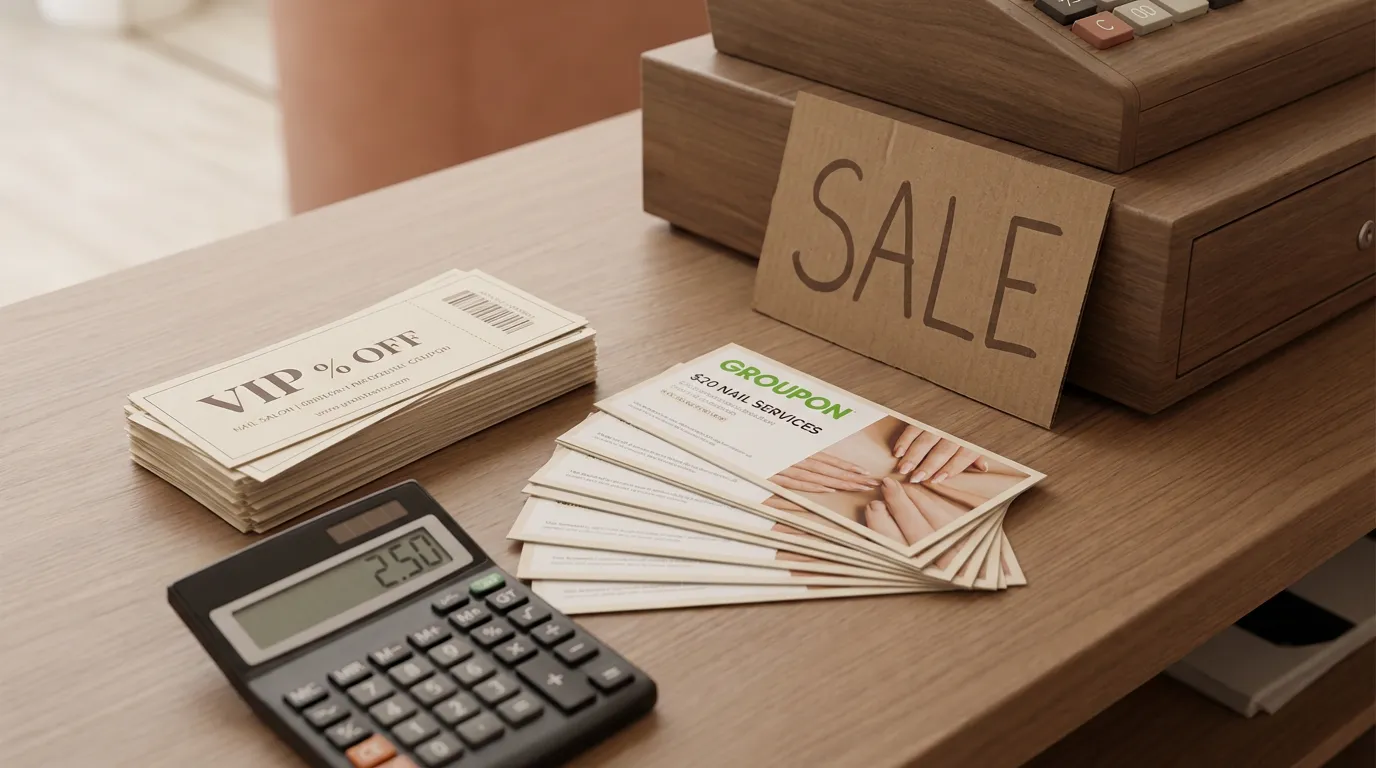
Every slow Tuesday, the same impulse kicks in: post a 20% off flash deal, blast it to the email list, maybe throw it on Groupon. The chair fills. The math does not.
A nail salon running a 15% net margin on a $52 mani-pedi keeps $7.80 per service. Offer 20% off and that ticket drops to $41.60. After product costs, labor, and overhead, the margin on that discounted service falls to roughly $1.50. You filled the chair. You barely covered the polish.
This is the trap. And the industry keeps walking into it.
Discounting Trains Clients to Wait for Deals
The damage from habitual discounting is not the margin hit on one Tuesday afternoon. The damage is behavioral. Clients learn patterns fast. If your salon runs a monthly slow-day special, a segment of your book will start shifting their appointments to catch it. Clients who would have paid $52 on a Thursday now wait until Wednesday’s deal goes live.
Booksy’s research on salon pricing calls this price erosion: customers grow accustomed to lower prices and hesitate to pay full rate. Over time, even loyal clients who once booked without checking for promotions start timing their visits around your deals.
You are not filling empty slots. You are moving full-price appointments into discounted ones.
The Groupon Math Nail Salons Ignore
Groupon remains the most common version of this mistake. The structure is brutal for service businesses. A typical Groupon deal requires the salon to discount its service by at least 50%. Groupon then takes its commission from the sale price. On a $52 mani-pedi offered at $26, the salon keeps roughly $13 to $15 after Groupon’s cut.
Product cost on that service runs $4 to $6. Tech labor, whether hourly or commission, runs $8 to $12 for the time slot. The salon loses money on every Groupon redemption before overhead even enters the equation.
The standard justification is acquisition. “We lose money on the deal but gain a client.” The data does not support it. According to discussion on Quora’s merchant forums, salon owners consistently report that Groupon customers are deal-seekers who do not convert to full-price regulars at meaningful rates. Many book once, never return, and move to the next salon running a deal.
You spent 45 minutes of chair time, consumed $5 in product, paid your tech, and acquired a client who was never yours.
What Actually Fills Empty Nail Salon Appointments
The alternative to discounting is not accepting empty chairs. The alternative is filling them without destroying your price floor.
Waitlists work. Automated waitlist systems recover 60-70% of last-minute cancellations that would otherwise sit empty. When a 2:00 PM Thursday opens up, a text goes to the three clients who wanted that slot. The chair fills at full price. Tools like Lutily’s scheduling features can automate this entirely so you are not manually calling down a list while your next client checks in.
Deposit policies reduce no-shows. A $10 to $15 deposit at booking cuts no-show rates dramatically. The industry average no-show rate runs 15-30% without deposits. Salons with deposit requirements report rates under 5%. Fewer no-shows means fewer empty slots to fill in the first place. If your salon loses $480 per week to no-shows, a deposit policy pays for itself before lunch on Monday.
Service bundling adds revenue without cutting price. “Book a pedicure, add a complimentary paraffin treatment” gives the client more value without discounting the anchor service. The paraffin costs you $2 in product. The client perceives $15 in value. Your base price stays intact.
The Price Floor Is the Business
A nail salon’s pricing structure is not a suggestion. It is a signal. Every discount communicates that the posted price was negotiable. Every Groupon deal tells walk-in clients they overpaid. Every slow-day special trains the book to wait.
Salons operating on 15-20% net margins cannot afford to give away 20% of a ticket and call it strategy. The math is zero-sum. If you need more clients in chairs, invest in the booking systems and policies that fill gaps at full rate. If you need more revenue per client, build the service menu and raise prices when costs demand it.
Stop discounting the chair. Start protecting the price.